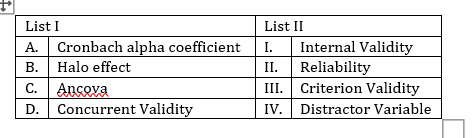
Correct option is D
Informal designs refer to experimental designs that do not follow a strict structure or randomization but are still used in research studies. These designs typically focus on simpler experimental setups and lack the complexity of formal designs. Let’s break down the options:
·
Before-and-after without control (A): This is an informal design, as it involves observing a change before and after an intervention without using a control group for comparison.
·
After-only control (B): This is also an informal design. It includes an observation after an intervention, with a control group for comparison, but lacks a pre-intervention measurement.
·
Latin square design (C): This is a
formal design, specifically a type of experimental design that controls for two potential sources of variation. It is more structured and involves randomization.
·
Before-and-after with control (D): This is an informal design, as it involves measuring changes before and after the intervention, while also using a control group to compare the results.
·
Completely randomized (E): This is also a
formal design, where subjects are randomly assigned to different treatment conditions. It is a structured experimental design.
Thus,
A,
B, and
D are informal designs.
Information Booster:
1.
Informal designs tend to be simpler and often used in real-world settings where strict experimental controls might be difficult to implement.
2.
Formal designs like Latin square or completely randomized designs are more structured and provide higher control over external variables.
3. The
Before-and-after without control design is simple but has the limitation of not accounting for external factors that might affect the outcome.
4. The
After-only control design can give some insights but still lacks the baseline measurement, making it less reliable for certain conclusions.
5.
Latin Square and
Completely Randomized designs are widely used for their rigor and ability to eliminate confounding variables.
Additional Information:
·
Before-and-after with control design can be very effective for comparing interventions, especially when randomization is not possible.
·
Completely randomized designs are often used in clinical trials to reduce bias by ensuring that each participant has an equal chance of being assigned to any treatment group.
 English
 150 Questions
 150 Marks
 150 Mins