






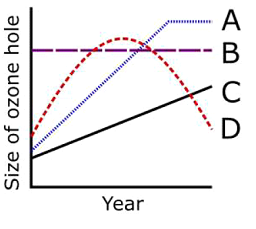
Correct option is A
The correct answer is Line A: It was growing but now it is not growing.
Explanation:
Line A represents the trend where the ozone hole grew significantly during the initial years due to the use of ozone-depleting substances (ODS) like CFCs but has stabilized in recent years. This aligns with real-world data showing that the ozone hole has stopped expanding due to international efforts, such as the Montreal Protocol, which curbed the use of substances that harm the ozone layer.
- Growth Phase: Initially, the ozone hole size increased rapidly because of widespread use of ODS, particularly in industrial applications and aerosols.
- Stabilization: After the implementation of the Montreal Protocol and its subsequent amendments, the production and usage of ODS were drastically reduced. Consequently, the ozone hole has stabilized in size, matching the trend depicted by Line A.
Information Booster:
- The Montreal Protocol (1987) was signed by over 190 countries to phase out ozone-depleting substances.
- The ozone hole is most noticeable over Antarctica due to the region's unique atmospheric conditions.
- Stabilization of the ozone hole is a significant step toward full recovery, expected by 2060 or later.
- Ozone is crucial for absorbing harmful ultraviolet (UV) radiation, protecting life on Earth from its damaging effects.
- The stabilization phase indicates global efforts' success but highlights the need for continued compliance with environmental treaties.
 English
 100 Questions
 100 Marks
 90 Mins


