Correct option is D
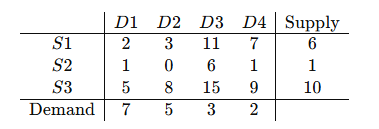
The North-West Corner Rule is a method used to determine an initial basic feasible solution for a transportation problem. It starts at the top-left (north-west) corner of the cost matrix and assigns as much as possible to that cell while reducing supply and demand accordingly.
Step-by-Step Allocation:
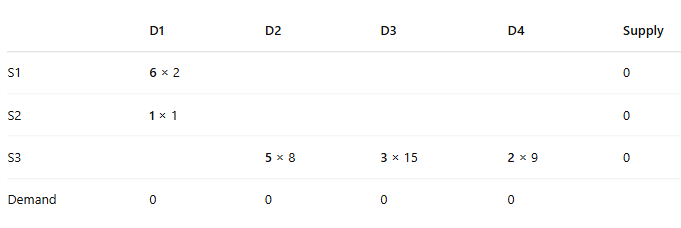
Step 6: Compute Total Cost
(6×2) + (1×1) + (5×8) + (3×15) + (2×9)
= 12 + 1 + 40 + 45 + 18
= 116
Information Booster:
The North-West Corner Rule provides a basic feasible solution for transportation problems.
It is easy to implement but does not guarantee the optimal solution.
Other methods, such as Least Cost Method (LCM) and Vogel’s Approximation Method (VAM), often yield a lower transportation cost.
The number of allocations in a basic feasible solution should be m + n - 1, where m is the number of sources and n is the number of destinations.
 English
 10 Questions
 20 Marks
 12 Mins