Correct option is A
An ideal voltage source has zero internal resistance. If it has no series resistor, its Thevenin equivalent remains the same ideal voltage source.

What is the Thevenin equivalent of an ideal voltage source (VS) with no series resistor?
An ideal voltage source has zero internal resistance. If it has no series resistor, its Thevenin equivalent remains the same ideal voltage source.
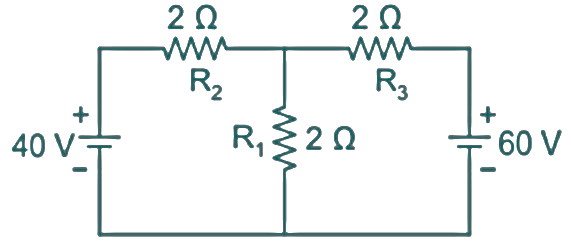
Determine the current through 2 Ω resistance nearer to the 60 V using the superposition theorem.
Which of the following theorem states that the current at one point in a circuit due to a voltage at a second point is the same as the current at the second point due to the same voltage at the first?
What is the Thevenin equivalent of an ideal voltage source (VS) with no series resistor?
A load resistance R_L is supplied from a dc voltage source of resistance R. Maximum power transfer to the load occurs when which of the following condition is satisfied?
How does impedance transformation in an AC circuit enhance power transfer?
The Superposition Theorem is particularly useful in which of the following types of circuits:


Determine the current through 2 Ω resistance nearer to the 60 V using the superposition theorem.
Which of the following theorem states that the current at one point in a circuit due to a voltage at a second point is the same as the current at the second point due to the same voltage at the first?
What is the Thevenin equivalent of an ideal voltage source (VS) with no series resistor?
A load resistance R_L is supplied from a dc voltage source of resistance R. Maximum power transfer to the load occurs when which of the following condition is satisfied?
How does impedance transformation in an AC circuit enhance power transfer?
The Superposition Theorem is particularly useful in which of the following types of circuits:
