
Correct option is C
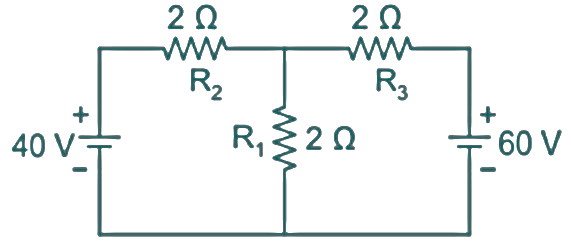
Case 1: Consider the 60 V voltage source
(40 V source will act as short-circuited)
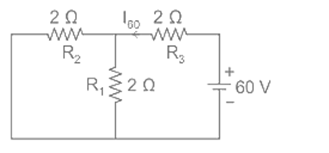
The two 2 Ω resistors are in parallel:
R₂₃ = (2 × 2) / (2 + 2) = 1 Ω
This is in series with R₁ = 2 Ω.
Equivalent resistance, Rₑq = 1 + 2 = 3 Ω
Current through R₁ due to the 60 V source:
I₆₀ = 60 / 3 = 20 A
Case 2: Consider the 40 V voltage source
(60 V source will act as short-circuited)
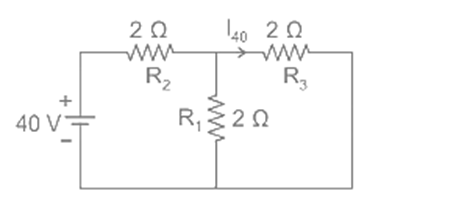
The two 2 Ω resistors R₁ and R₃ are in parallel:
R₁₃ = (2 × 2) / (2 + 2) = 1 Ω
This is in series with R₂ = 2 Ω.
Equivalent resistance, Rₑq = 1 + 2 = 3 Ω
Current from the 40 V source:
I = 40 / 3 = 13.33 A
Using the current-divider rule, current through R₁ is:
I₄₀ = 13.33 × (2 / (2 + 2)) = 6.67 A
Net current through the 2 Ω resistor nearer to 60 V
The two currents flow in opposite directions.
I = I₆₀ − I₄₀
I = 20 − 6.67 = 13.33 A


