Correct option is B
From the growth data on SC-URA medium:
- Cell Type 1 grows in both log and stationary phase (+ , +).
- Cell Type 2 grows only in stationary phase (- , +).
- Cell Type 3 does not grow in either phase (- , -).
Assessing Each Statement:
Statement A: "URA3 gene in cell type 1 is probably located in a heterochromatic region."
- Incorrect
- Since Cell Type 1 grows in both phases, URA3 is actively expressed, meaning it is not in heterochromatin.
Statement B: "URA3 gene in cell type 2 is located in facultative heterochromatin."
- Correct
- Cell Type 2 does not grow in log phase but grows in stationary phase.
- This indicates that URA3 is silenced in log phase but activated in stationary phase, which is characteristic of facultative heterochromatin.
Statement C: "URA3 gene in cell type 2 is probably located in a chromosome region silenced in log phase."
- Incorrect
- While URA3 is inactive in log phase, the statement is redundant with B.
- Since B is a more precise characterization, C is not needed as a separate correct answer.
Statement D: "URA3 gene in cell type 3 is heterochromatinized in log phase."
- Correct
- Cell Type 3 does not grow in either phase, meaning URA3 is permanently silenced.
- This suggests that URA3 is in constitutive heterochromatin or is heavily repressed.
- The phrase "heterochromatinized in log phase" implies it is already silent in log phase, which aligns with the data.
Option 2 (B and D) is correct.
Information Booster
- Euchromatin – Open, transcriptionally active chromatin.
- Facultative heterochromatin – Can switch between active and silent states (e.g., Cell Type 2).
- Constitutive heterochromatin – Always silenced (e.g., Cell Type 3).
- Position-effect variegation (PEV) – Gene silencing based on chromatin positioning.
- Chromatin modifications – H3K9 methylation promotes heterochromatin, while H3K9 acetylation promotes euchromatin.
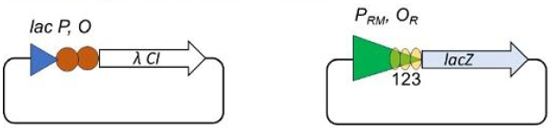
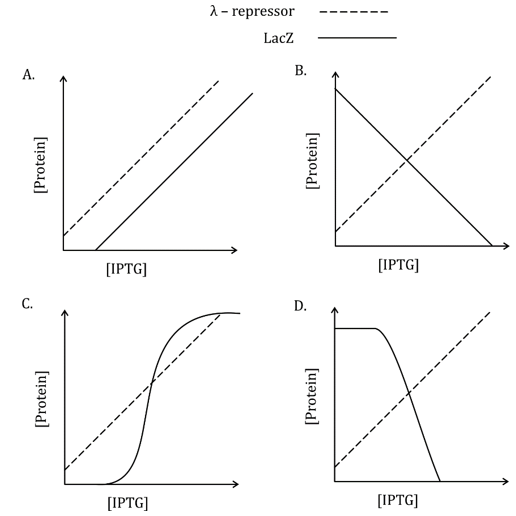
 which one of the following statements about the regulation by CI and Cro proteins is CORRECT?