arrow
arrow
arrow
Two streams A and B are flowing with flow rates of 20 m³/s and 5 m³/s respectively. The concentration of a pollutant X in the two streams are 15 mg/l
Question


Two streams A and B are flowing with flow rates of 20 m³/s and 5 m³/s respectively. The concentration of a pollutant X in the two streams are 15 mg/l (stream A) and 50 mg/l (stream B). The two streams join each other. Assume that complete mixing of the streams occurs after joining and the pollutant is a conservative substance. The downstream concentration of the pollutant after the joining of two streams would be:

A.

30 mg/l

B.

27 mg/l

C.

25 mg/l

D.

22 mg/l

Correct option is D


Given Data:
· Flow rate of Stream A (QAQ_AQA​) = 20 m³/s
· Flow rate of Stream B (QBQ_BQB​) = 5 m³/s
· Pollutant concentration in Stream A (CAC_ACA​) = 15 mg/l
· Pollutant concentration in Stream B (CBC_BCB​) = 50 mg/l
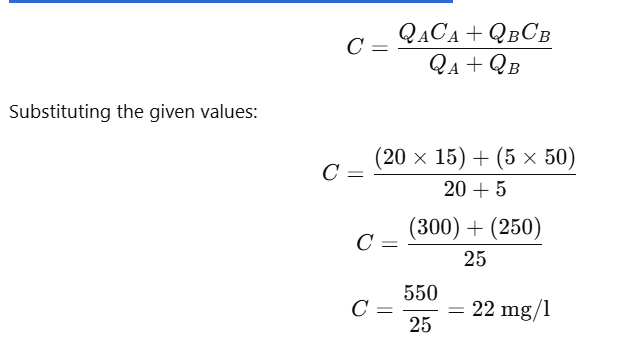
Formula Used (Mass Balance Equation):
Explanation:
The conservative pollutant does not degrade or react, meaning the mass remains the same. After mixing, the concentration is determined based on the weighted average of the pollutant loads from both streams. Since Stream B has a higher pollutant concentration, but a lower flow rate, the final concentration (22 mg/l) is closer to Stream A’s value but influenced by Stream B.
Information Booster:
· Conservative pollutants remain unchanged in chemical composition (e.g., salts, heavy metals).
· Non-conservative pollutants degrade over time (e.g., organic matter, biodegradable substances).
· The mass balance equation helps in predicting water quality changes in rivers, lakes, and wastewater treatment plants.
· Flow rate plays a crucial role—a higher flow rate dilutes the pollutant more effectively.
· Pollution dilution studies are important for environmental impact assessments.
· Mixing assumptions: This calculation assumes instantaneous and complete mixing of pollutants.
· Real-world applications include river pollution control, wastewater treatment, and hydrology studies.

Free Tests

Free
Must Attempt

Basics of Education: Pedagogy, Andragogy, and Hutagogy

languageIcon English
  • pdpQsnIcon10 Questions
  • pdpsheetsIcon20 Marks
  • timerIcon12 Mins
languageIcon English
Free
Must Attempt

UGC NET Paper 1 Mock Test 1

languageIcon English
  • pdpQsnIcon50 Questions
  • pdpsheetsIcon100 Marks
  • timerIcon60 Mins
languageIcon English
Free
Must Attempt

Basics of Education: Pedagogy, Andragogy, and Hutagogy

languageIcon English
  • pdpQsnIcon10 Questions
  • pdpsheetsIcon20 Marks
  • timerIcon12 Mins
languageIcon English

Similar Questions

test-prime-package

Access ‘UGC NET EVS’ Mock Tests with

  • 60000+ Mocks and Previous Year Papers
  • Unlimited Re-Attempts
  • Personalised Report Card
  • 500% Refund on Final Selection
  • Largest Community
students-icon
353k+ students have already unlocked exclusive benefits with Test Prime!
Our Plans
Monthsup-arrow