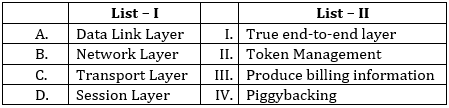
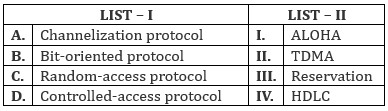
Correct option is C
We are given:
Computer A
- IP Address: 203.197.2.53
- Subnet Mask: 255.255.128.0
Computer B
- IP Address: 203.197.75.201
- Subnet Mask: 255.255.192.0
We must determine whether each computer considers the other to be on the same network or a different network.
Step 1: Understand the Subnet Masks
A’s Subnet Mask
255.255.128.
Binary:
11111111.11111111.10000000.00000000
This corresponds to:
/17
Meaning:
- First 17 bits = Network portion
- Remaining bits = Host portion
B’s Subnet Mask
255.255.192.0
Binary:
11111111.11111111.11000000.00000000
This corresponds to:
/18
Meaning:
- First 18 bits = Network portion
Step 2: Check A’s View of B
A uses subnet mask:
255.255.128.0
So, A checks whether B belongs to the same /17 network.
A’s Network Address
IP:
203.197.2.53
Third octet = 2
With /17:
- Network ranges are:
- 0–127
- 128–255
Since 2 lies in:
0 − 127
A’s network is:
203.197.0.0/17
B’s IP
203.197.75.201
Third octet = 75
75 also lies in:
0 − 127
Thus, B also belongs to:
203.197.0.0/17
Therefore:
Step 3: Check B’s View of A
B uses subnet mask:
255.255.192.0
i.e. /18.
With /18:
- Third octet ranges become:
- 0–63
- 64–127
- 128–191
- 192–255
B’s Network
B’s IP:
203.197.75.201
Third octet = 75
75 lies in:
64 − 127
So, B belongs to:
203.197.64.0/18
A’s IP
203.197.2.53
Third octet = 2
2 lies in:
0 − 63
So, A belongs to:
203.197.0.0/18
Thus, A and B are in different /18 networks.
Therefore:
Final Conclusion
- A thinks B is on the same network.
- B thinks A is on a different network.
Correct Answer
Information Booster
1. Subnetting Rule
Two hosts are considered on the same network if:
(IP AND Subnet Mask)
gives the same network address.
2. CIDR Notation
| Subnet Mask | CIDR |
| 255.255.128.0 | /17 |
| 255.255.192.0 | /18 |
3. Important Concept
Communication assumptions may become asymmetric when hosts use different subnet masks. One host may think the destination is local while the other thinks it is remote.
 English
 10 Questions
 20 Marks
 12 Mins