Correct option is A
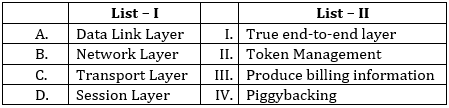
Data Link Layer (A - IV): This layer is responsible for
piggybacking, which involves combining data with acknowledgment information to optimize communication efficiency.
Network Layer (B - III): The
Network Layer handles
billing information production, as it tracks data usage and routing for network management.
Transport Layer (C - I): The
Transport Layer is considered the
true end-to-end layer, as it ensures reliable communication and data delivery across devices.
Session Layer (D - II): The
Session Layer is responsible for
token management, which regulates the sequence of communication and ensures that only one party transmits at a time in a session.
Information Booster
1.
OSI Model Overview:
· The
OSI Model consists of 7 layers, each responsible for specific tasks in networking:
1. Physical Layer
2. Data Link Layer
3. Network Layer
4. Transport Layer
5. Session Layer
6. Presentation Layer
7. Application Layer
2.
Data Link Layer Functions:
· Error detection and correction.
· Data framing and flow control.
· Protocols: Ethernet, Wi-Fi, etc.
3.
Network Layer Functions:
· Routing and forwarding data packets.
· Logical addressing (IP addresses).
· Protocols: IPv4, IPv6, ICMP, etc.
4.
Transport Layer Functions:
· End-to-end communication and reliability.
· Flow and error control.
· Protocols: TCP (reliable) and UDP (unreliable).
5.
Session Layer Functions:
· Establishing, maintaining, and terminating communication sessions.
· Synchronization and token management.
Additional Knowledge
·
Piggybacking optimizes communication by sending acknowledgment information alongside data frames.
· The
Transport Layer ensures data segmentation, sequencing, and reassembly for end-to-end communication.
· The
Session Layer's token management is crucial in scenarios requiring controlled communication, such as video conferencing or file transfers.
 English
 10 Questions
 20 Marks
 12 Mins