Correct option is B
According to the question,
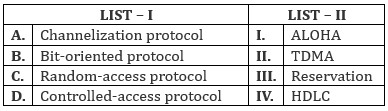
Channelization Protocol (A):
· Definition: Channelization protocols divide the available bandwidth into multiple channels, allowing multiple users to use the same bandwidth simultaneously.
· Example: Time Division Multiple Access (TDMA) is a channelization protocol that allocates distinct time slots to each user for communication.
· Match: II. TDMA because TDMA is a classic example of a channelization protocol.
Bit-oriented Protocol (B):
· Definition: Bit-oriented protocols use bit-level operations to frame the data and include control information within the data stream.
· Example: High-level Data Link Control (HDLC) is a bit-oriented protocol that frames data in bits rather than bytes.
· Match: IV. HDLC because HDLC is a well-known bit-oriented protocol.
Random-access Protocol (C):
· Definition: Random-access protocols allow devices to transmit data whenever the channel is free, leading to potential collisions that are then resolved using specific algorithms.
· Example: ALOHA is a random-access protocol where devices transmit whenever they have data, leading to a simple collision detection and retransmission mechanism.
· Match: I. ALOHA because ALOHA is a fundamental example of a random-access protocol.
Controlled-access Protocol (D):
· Definition: Controlled-access protocols allocate resources in a controlled manner to avoid collisions and ensure orderly access.
· Example: Reservation protocols control access by allowing devices to reserve the channel for transmission.
· Match: III. Reservation because reservation is a typical controlled-access protocol, ensuring orderly access to the communication channel.
By understanding these definitions and examples, we can see why each match is correct.
 English
 10 Questions
 20 Marks
 12 Mins