Correct option is B
Ans.(b)
For hydrogen atom total energy of an electron in the

stationary orbit is








The total energy of an electron in the nth stationary orbit of the hydrogen atom can be obtained by
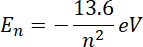
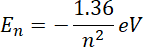

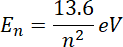
Ans.(b)
For hydrogen atom total energy of an electron in the
stationary orbit is
 English
 200 Questions
 720 Marks
 200 Mins English English200 Questions720 Marks200 Mins English
An electron in a hydrogen atom (Bohr model) makes a transition from n = 2 state to n = 1 state. The frequency of the emitted photon is (take R = 1.0 × ):
Rutherford scattering proved the:
Suppose that an alpha particle of 4.50 MeV approaches head-on a uranium nucleus (Z = 92). Assuming that the uranium nucleus remains at rest and the alpha particle momentarily comes to rest and reverses its direction at a distance much more than the radius of the uranium nucleus, the distance of its closest approach is close to:
Consider the mass of iron nucleus as 55.85 u and A = 56. Then the nuclear density is:
Consider two nuclei, A of mass number 27 and B of mass number 64. Considering them as liquid-drops, the ratio of their densities will be:
The ratio of the longest wavelength to the shortest wavelength () in Brackett series of hydrogen spectrum is:
Rutherford scattering experiment is based on:
Suppose that an alpha particle of 3.20 MeV approaches head-on a lead nucleus (Z = 82). Assuming that the lead nucleus remains at rest and the alpha particle momentarily comes to rest and reverses its direction at a distance much more than the radius of the lead nucleus, the distance of its closest approach is:
The ratio of the longest wavelength to the shortest wavelength ( in Paschen series of hydrogen spectrum is:
Consider the solar system as a large atom. The quantum number (n) that characterises Earth's orbit (radius = 1.5 × m) with Earth moving at an orbital speed of 3 × m/s is (mass of Earth is 6 × kg):
Suggested Test Series

Suggested Test Series