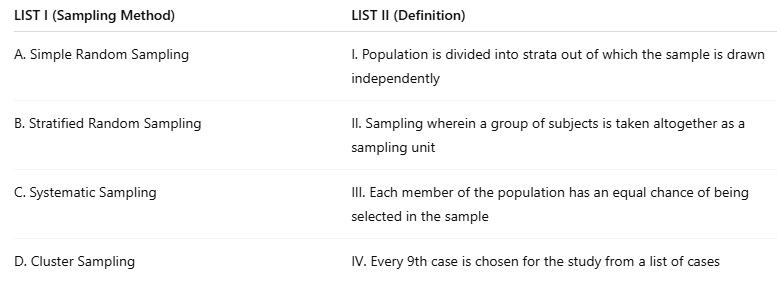
Correct option is B
The Thurstone Equal-Appearing Interval Scale is a method used to measure attitudes by selecting statements that represent equal intervals along a continuum of favorability. The sequential steps in constructing this scale are:
1. Collection and Editing of Items (A):
· Gather a large number of statements related to the attitude being measured.
· Ensure that statements cover a wide range of opinions.
2. Calculating Scale and Q Values (B):
· Experts rate each item on a continuum from least favorable to most favorable.
· Calculate scale values (median score) and Q values (interquartile range) to determine item placement.
3. Sorting Items on Different Continuum (D):
· Items are placed along a scale based on their median scale value.
· Only items with low Q values (indicating high agreement among judges) are retained.
4. Finalization of Items (C):
· Select final items that are evenly spaced along the attitude continuum.
· Remove ambiguous or inconsistent items.
Thus, the correct sequence is A → B → D → C, making the correct answer (b) A, B, D, C.
Information Booster:
Characteristics of the Thurstone Scale:
Uses equal-appearing intervals to measure attitudes. Items are selected based on expert judgment. Avoids bias by ensuring uniform item distribution. Provides precise and reliable measurement of attitudes.
Why Use the Thurstone Scale?
· Suitable for complex attitudinal studies.
· More accurate than Likert scales for distinguishing subtle attitude differences.
· Helps in psychological and social research where graded responses are needed.
This method ensures a balanced representation of different attitude levels, making it highly effective in attitude measurement.
 English
 10 Questions
 20 Marks
 12 Mins