






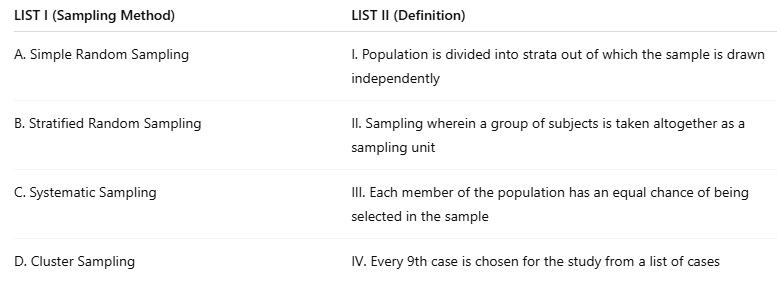
Correct option is B
Simple Random Sampling (A): In this method, every member of the entire population has an equal chance of being selected. The selection process is entirely random, often using random number tables or computerized random generators. This approach ensures fairness and unbiased representation. For example, if you want to survey 100 students out of 1,000, you assign each student a number and randomly pick 100 numbers. It matches
III: Each member of the population has an equal chance of being selected in the sample.
·
Advantages: Easy to understand and implement, unbiased results.
·
Disadvantages: Requires a complete list of the population and may be inefficient if the population is large and spread out.
Stratified Random Sampling (B): Here, the population is divided into distinct subgroups or strata (e.g., gender, age, income level), and samples are drawn independently from each stratum proportionally or equally. This method ensures representation from all key segments, improving the accuracy and relevance of the results. For example, if a population is 60% female and 40% male, the sample will reflect this ratio. This matches
I: Population is divided into strata out of which the sample is drawn independently.
·
Advantages: More precise estimates than simple random sampling, especially if strata differ significantly.
·
Disadvantages: Requires knowledge of strata beforehand and can be more complex to administer.
Systematic Sampling (C): This method involves selecting every kth individual from a population list after a random start. For example, if you choose every 9th case from a list, you randomly pick a starting point between 1 and 9, then select every 9th individual thereafter. This method is simple and quick, matching
IV: Every 9th case is chosen for the study from a list of cases.
·
Advantages: Easy to implement, less time-consuming than simple random sampling.
·
Disadvantages: Can introduce bias if the list has a hidden pattern that coincides with the sampling interval.
Cluster Sampling (D): In cluster sampling, the population is divided into groups or clusters (e.g., villages, schools), and whole clusters are randomly selected for study. Instead of sampling individuals, entire clusters are included. This method is practical when the population is large and spread over a wide area. It matches
II: Sampling wherein a group of subjects is taken altogether as a sampling unit.
·
Advantages: Cost-effective and practical for large, dispersed populations.
·
Disadvantages: Less precise than other methods due to similarities within clusters, requiring larger sample sizes to achieve accuracy.
Information Booster
Choosing the right sampling method depends on the research objectives, population characteristics, and available resources. Simple random and stratified sampling offer more precision, while systematic and cluster sampling improve efficiency. Understanding these methods helps researchers design studies that balance accuracy, cost, and feasibility.
 English
 10 Questions
 20 Marks
 12 Mins


