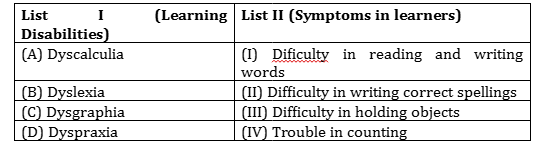
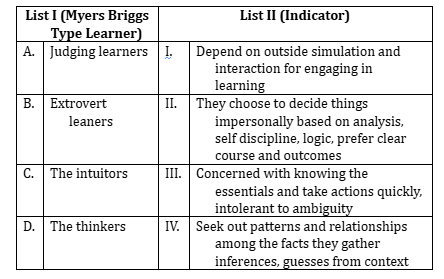
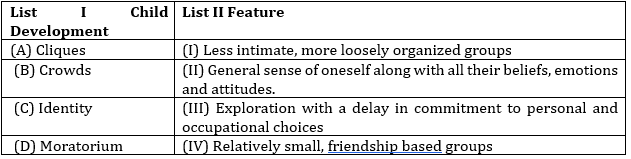
Correct option is C
The
Choice Based Credit System (CBCS) introduced the provision for earning credits through optional and elective courses in higher education institutions. This system allows students the flexibility to choose courses from a range of core, elective, and skill-based subjects according to their interests and career goals.
Information Booster 1. CBCS was introduced under the guidelines of the University Grants Commission (UGC) in India.
2. The system aims to promote interdisciplinary education and equip students with diverse skill sets.
3. It involves a grading system, replacing traditional marks-based evaluation.
4. Credit transfer across institutions is facilitated by CBCS, enhancing mobility.
5. CBCS integrates innovative learning methods such as project work, case studies, and open-book assessments.
Additional Knowledge
(a) Academic Bank of Credit: This is an initiative by the Ministry of Education that allows students to store and transfer earned credits between recognized institutions. It facilitates the accumulation of credits for a degree and supports lateral entry or exit. Unlike CBCS, it focuses on digitizing and storing academic credits.
(b) MOOCs on SWAYAM portal: The SWAYAM platform offers Massive Open Online Courses (MOOCs) for students to learn diverse subjects. While MOOCs contribute to earning credits in certain institutions, they are part of CBCS and not the primary framework for credit allocation.
(d) Vocational courses: These courses emphasize skill-based training for employability. While vocational courses may align with CBCS as electives, they are not the system introducing credits for optional courses.
 English
 10 Questions
 20 Marks
 12 Mins