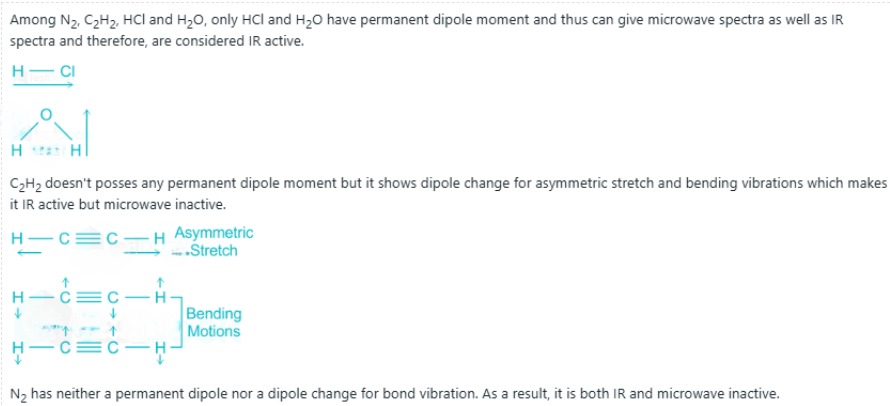
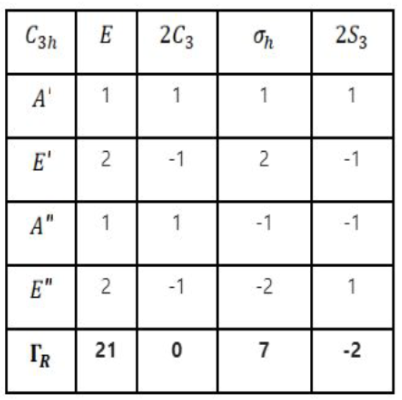
Correct option is B
Infrared spectroscopy (IR spectroscopy or vibrational spectroscopy) is the measurement of the interaction of infrared radiation with matter by absorption, emission, or reflection. It is used to study and identify chemical substances or functional groups in solid, liquid, or gaseous forms. It can be used to characterize new materials or identify and verify known and unknown samples.
The infrared portion of the electromagnetic spectrum is usually divided into three regions; the near-, mid- and far- infrared, named for their relation to the visible spectrum. The higher-energy near-IR, approximately 14,000–4,000 cm-1 (0.7–2.5 μm wavelength) can excite overtone or combination modes of molecular vibrations. The mid-infrared, approximately 4,000–400 cm-1 (2.5–25 μm) is generally used to study the fundamental vibrations and associated rotational–vibrational structure. The far-infrared, approximately 400–10 cm-1 (25–1,000 μm) has low energy and may be used for rotational spectroscopy and low frequency vibrations.
In order for a vibrational mode in a sample to be "IR active", it must be associated with changes in the molecular dipole moment. A permanent dipole is not necessary, as the rule requires only a change in dipole moment.
Simple diatomic molecules have only one bond and only one vibrational band. If the molecule is symmetrical, e.g. N2 , the band is not observed in the IR spectrum.
Rotational spectroscopy is concerned with the measurement of the energies of transitions between quantized rotational states of molecules in the gas phase. The rotational spectrum (power spectral density vs. rotational frequency) of polar molecules can be measured in absorption or emission by microwave spectroscopy or by far infrared spectroscopy. For rotational spectroscopy, molecules are classified according to symmetry into spherical tops, linear molecules, and symmetric tops; analytical expressions can be derived for the rotational energy terms of these molecules.
Transitions between rotational states can be observed in molecules with a permanent electric dipole moment. A consequence of this rule is that no microwave spectrum can be observed for centrosymmetric linear molecules such as N2 (dinitrogen) or HCCH (ethyne), which are non-polar.