Correct option is A
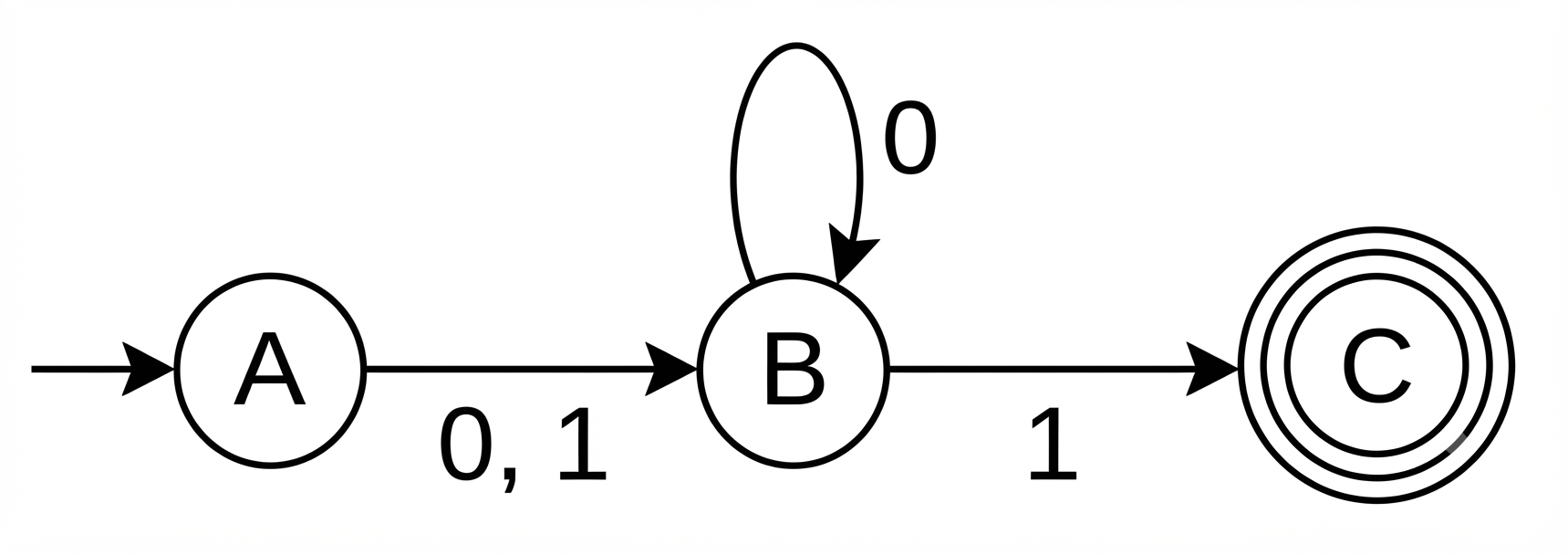
The minimum state deterministic finite automaton (DFA) equivalent to the given state transition diagram is represented by Option (a).
Step-by-Step Solution and Analysis
· Transition Breakdown:
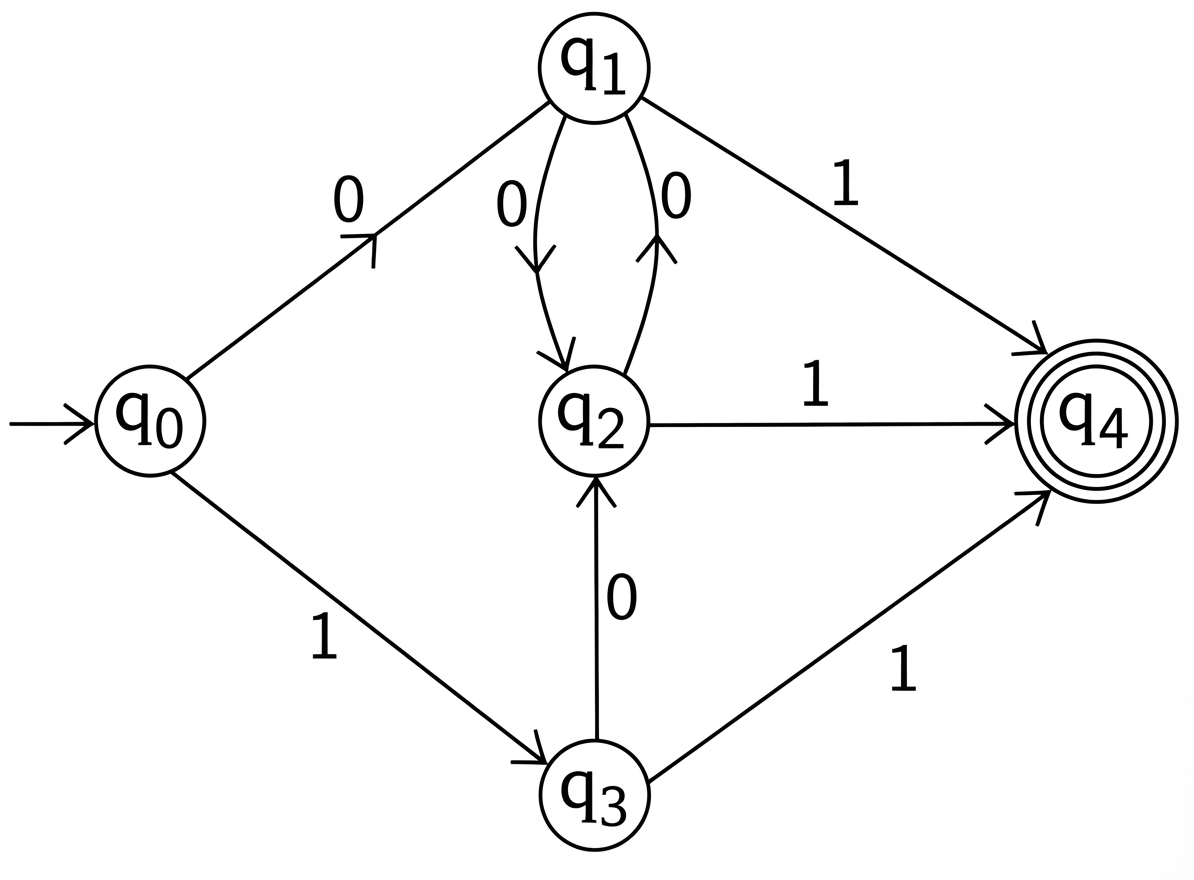
· The initial state is . On input symbols 0 or 1, it transitions into the intermediate region containing states and .
· States and form a mutual loop on input 0 , and state routes to on input 0.
· From any of the intermediate states or reading an input 1 directly leads to the final accepting state .
· Language Identification:
· Tracing the valid execution paths yields strings that begin with either 0 or 1, followed by any arbitrary sequence of 0s (via the cycle), and terminate with 1.
· This defines the regular expression:
· State Minimization (Equivalence Partitioning):
· State A: Corresponds to the initial start state . On inputs 0 or 1, it transitions to the next phase.
· State B: States and are equivalent because upon receiving input 0 they remain within the internal loop subset, and upon receiving input 1 they transition directly to the final acceptance state. They can be merged into a single minimized state (State B) with a self-loop on 0
· State C: Corresponds to the final accepting state reached from State B on input 1 ().
Additional Knowledge:
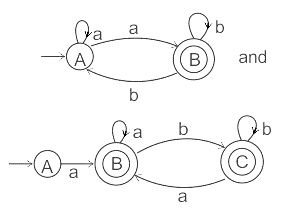
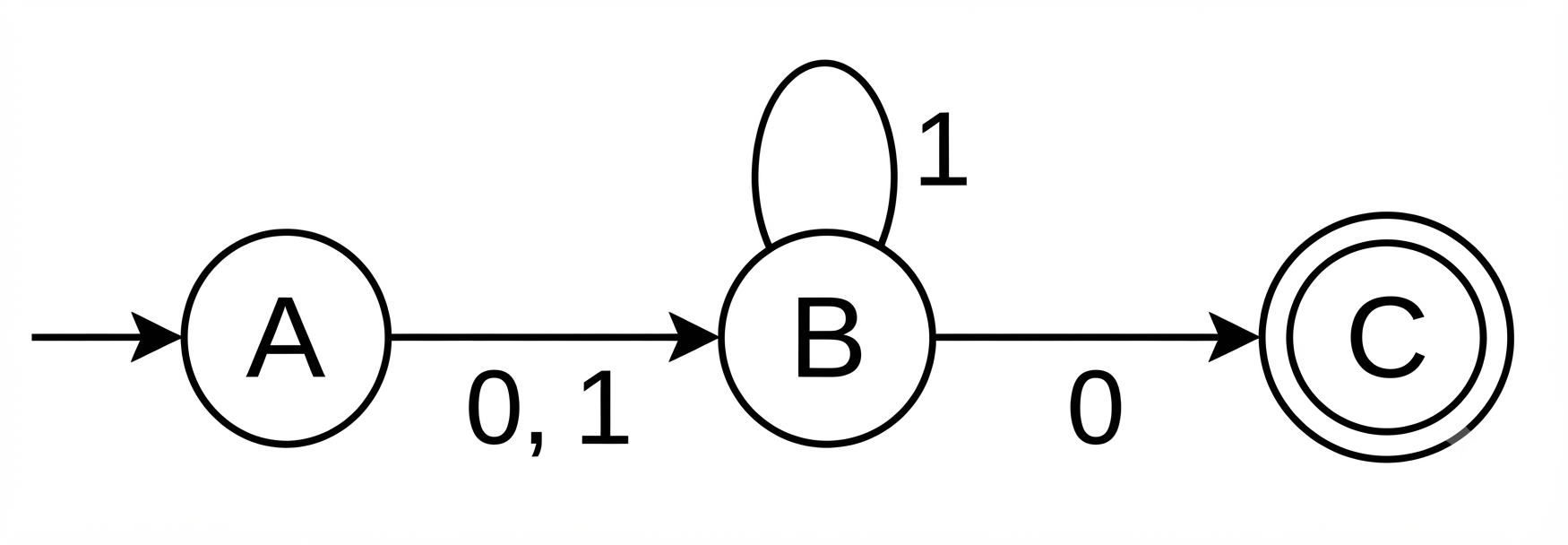
· Option (b): This option incorrectly configures the transition to the final state C by assigning a 0 input label instead of 1, and places a 1-loop on state B instead of a 0-loop. This changes the accepted language to strings ending in 0 preceded by 1s, which does not match the behavior of the original automaton.
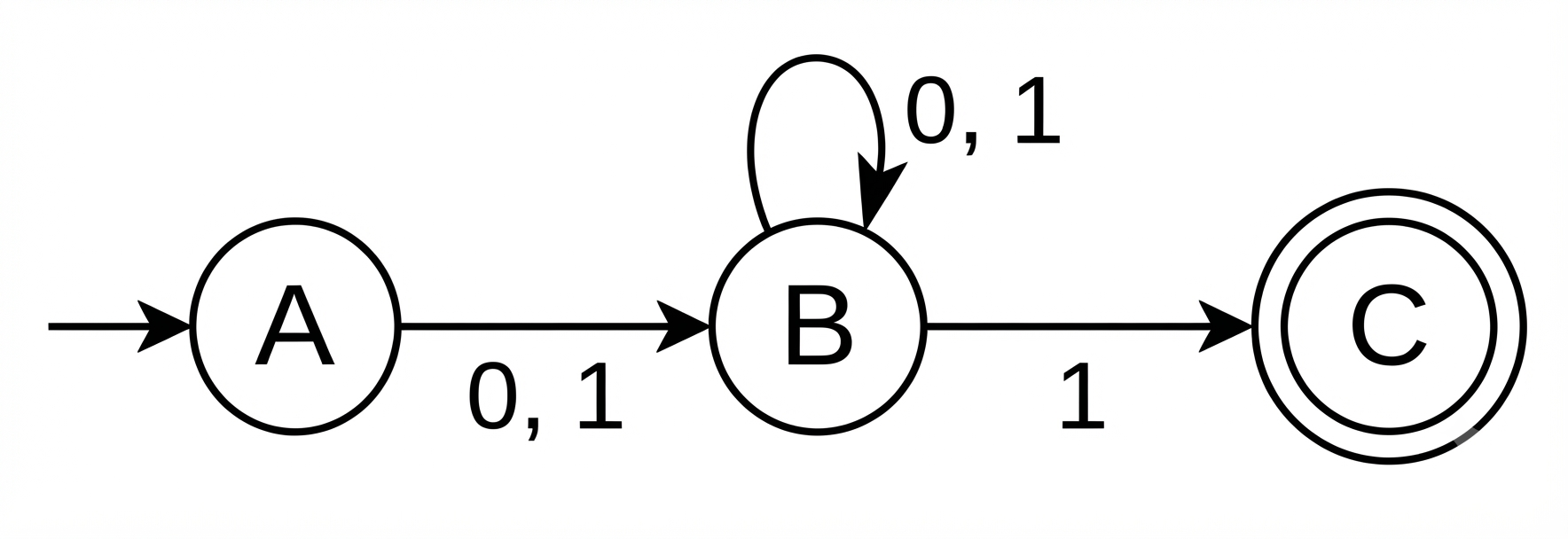
· Option (c): This option places a combined 0, 1 self-loop on the intermediate state B. This allows any arbitrary sequence of 0s and 1s after the initial transition, incorrectly accepting strings that do not follow the required termination condition of the original diagram.
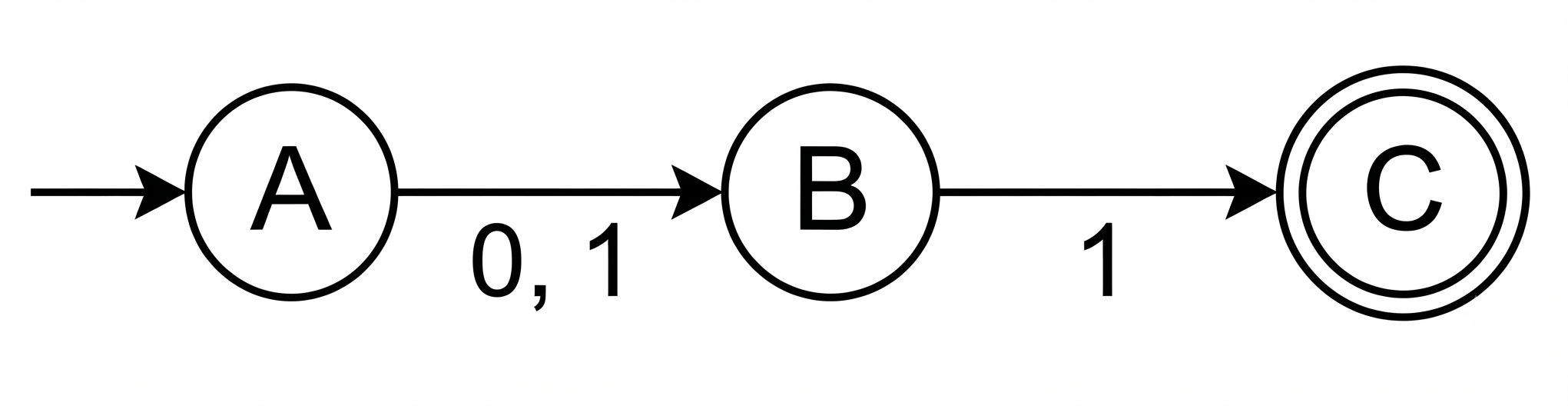
· Option (d): This option completely omits the self-loop on state B. Without this loop, the machine is restricted to accepting only length-2 strings and fails to account for the arbitrary sequence of intermediate 0s represented in the original state graph.
 English
 10 Questions
 20 Marks
 12 Mins