hamburger menu
All Coursesall course arrow
adda247
reward-icon
adda247
    arrow
    arrow
    arrow
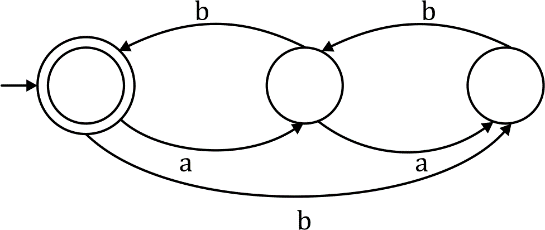
    Find the regular expression for the language accepted by the automata given below:
    Question

    Find the regular expression for the language accepted by the automata given below:

    A.

    (aa(a+b)ab)(aa^*(a+b)ab)^*​​

    B.

    (a+b)ab(ab+bb+aa(a+b)ab)(a+b)ab(ab+bb+aa^*(a+b)ab)^*​​

    C.

    aab(ab+bb+aa(a+b)ab)a^*ab(ab+bb+aa^*(a+b)ab)^*​​

    D.

    a(a+b)ab(ab+bb+aa(a+b)ab)a^*(a+b)ab(ab+bb+aa^*(a+b)ab)^*​​

    Correct option is A

    We are given a finite automaton and asked to identify the correct regular expression representing its language.
    Step 1: Key Observation

    • The initial state is also an accepting state (double circle)

    =>εL\Rightarrow \varepsilon \in L​​
    Therefore, any valid regular expression must generate ε.\varepsilon.
    Step 2: Structure of the Automaton
    From the diagram:

    • There are three states connected using transitions labeled a and b
    • The automaton contains cycles, meaning:
      • Repetition of patterns is allowed
    • Movement pattern:
      • ‘a’ generally moves forward
      • ‘b’ helps in transitions and returning paths

    Hence, the language consists of:

    • ε\varepsilon​​
    • Repeated structured sequences of a’s and b’s

    Step 3: Expected Form of Regular Expression
    Since:

    • Cycles exist → repetition needed
    • Start state is accepting → ε\varepsilon​ must be included

    The regular expression must be of the form:
    (R)(R)^*​​
    Step 4: Evaluate Option (a)
    (aa(a+b)ab)(aa^*(a+b)ab)^*​​
    Breakdown:

    • aaaa^* →​ at least one aa+‘a’ → a^+
    • (a + b) → either ‘a’ or ‘b’
    • ab → fixed suffix

    So, one block generates:
    a+(a+b)aba^+(a+b)ab​​
    Applying Kleene star:
    (aa(a+b)ab)(aa^*(a+b)ab)^*​​
    This means:

    • Zero or more repetitions of the block
    • Hence:
      • ε\varepsilon​ is included
      • Repetition supported

    Step 5: Consistency with Automaton

    Property

    FA

    Option (a)

    ε\varepsilon​ accepted

    Yes

    Yes

    Repetition

    Yes

    Yes

    Uses a & b

    Yes

    Yes

    Cyclic behavior

    Yes

    Yes

    Fully consistent
    Step 6: Why Other Options Are Incorrect?

    • They do not have Kleene star at the outermost level, hence:
      • Do not generate ε
      • Impose minimum length constraint
    • Therefore, they cannot represent the given automaton

    Final Answer
    (a) (aa(a+b)ab)\boxed{(a)\ (aa^*(a+b)ab)^*}​​
    Important Exam Insight

    • If start state is accepting, always check:

    εL\varepsilon \in L​​

    • Only expressions with:
      • Kleene star (*)
      • or explicit ε\varepsilon
        can satisfy this

    Key Takeaway
    Presence of outermost Kleene star is a strong indicator that:

    • ε\varepsilon​ is included
    • Cyclic behavior is captured

    Free Tests

    Free
    Must Attempt

    Basics of Education: Pedagogy, Andragogy, and Hutagogy

    languageIcon English
    • pdpQsnIcon10 Questions
    • pdpsheetsIcon20 Marks
    • timerIcon12 Mins
    languageIcon English
    Free
    Must Attempt

    UGC NET Paper 1 Mock Test 1

    languageIcon English
    • pdpQsnIcon50 Questions
    • pdpsheetsIcon100 Marks
    • timerIcon60 Mins
    languageIcon English
    Free
    Must Attempt

    Basics of Education: Pedagogy, Andragogy, and Hutagogy

    languageIcon English
    • pdpQsnIcon10 Questions
    • pdpsheetsIcon20 Marks
    • timerIcon12 Mins
    languageIcon English

    Similar Questions

    test-prime-package

    Access ‘UGC NET Computer Science’ Mock Tests with

    • 60000+ Mocks and Previous Year Papers
    • Unlimited Re-Attempts
    • Personalised Report Card
    • 500% Refund on Final Selection
    • Largest Community
    students-icon
    414k+ students have already unlocked exclusive benefits with Test Prime!
    Our Plans
    Monthsup-arrow