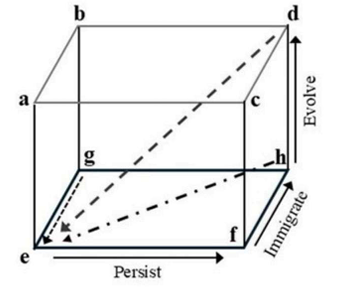
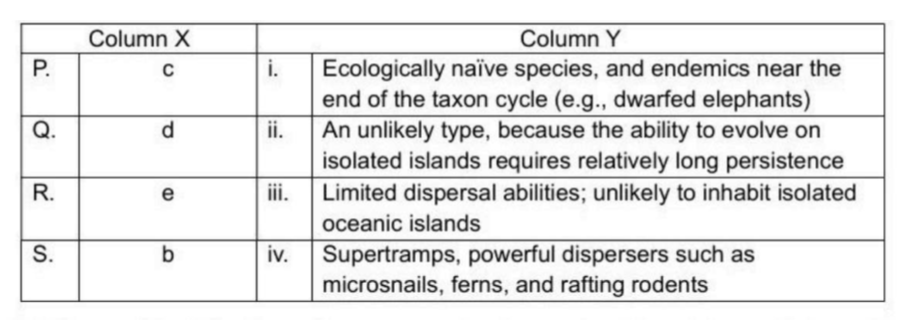
Correct option is D
Explanation-
Statement A: "Adaptive radiation is a kind of divergent evolution driven by ecological diversification."
Correct
Adaptive radiation involves the evolution of different species from a common ancestor as they adapt to different ecological niches. It is a classic example of divergent evolution driven by ecological opportunity or diversification.
Statement B: "Adaptive radiation is the divergence of unrelated taxa into different niches."
Incorrect
Adaptive radiation occurs within related taxa (from a common ancestor), not unrelated ones. The divergence of unrelated taxa into different niches would not be called adaptive radiation — rather, it's convergent evolution or general diversification.
Statement C: "Adaptive radiation is rare on archipelagos removed from the mainland."
Incorrect
This is actually the opposite of what is observed. Adaptive radiation is common on isolated archipelagos (e.g., Galápagos Islands), where a single ancestral species can give rise to many new species that occupy different niches.
Statement D: "Processes unrelated to niche exploitation can be major drivers of species diversification."
Correct
Although adaptive radiation often involves niche exploitation, other processes like genetic drift, mutation, and geographical isolation can also lead to species diversification.
Correct answer is option d - A and D
These two statements are scientifically accurate regarding adaptive radiation.