Correct option is C
Reproductive isolation is classified into prezygotic and postzygotic mechanisms:
- Prezygotic isolation occurs before fertilization, preventing different species from mating or forming a zygote.
- Postzygotic isolation occurs after fertilization, leading to reduced survival or fertility of the offspring.
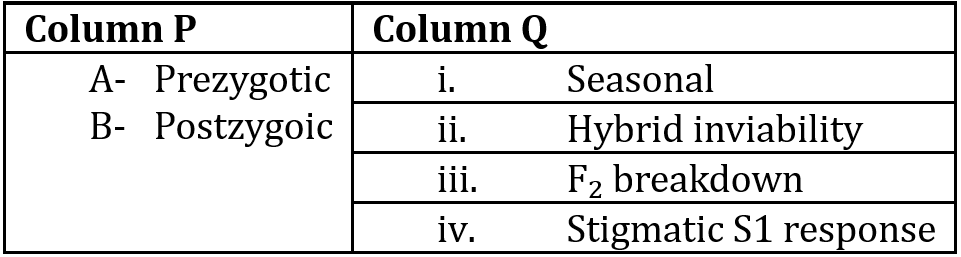
Matching Column P (Isolation Type) with Column Q (Processes):
Prezygotic Isolation (A):
- i. Seasonal isolation: Prevents interbreeding due to differences in mating seasons (also called temporal isolation). (Correct for prezygotic)
- iv. Stigmatic SI response: Refers to self-incompatibility (SI) mechanisms in plants, preventing pollen from fertilizing eggs of different species. (Correct for prezygotic)
Postzygotic Isolation (B):
- ii. Hybrid inviability: Occurs when the zygote forms but fails to develop properly, leading to early death. (Correct for postzygotic)
- iii. F₂ breakdown: Refers to hybrid offspring (F₂ generation) being weak, sterile, or inviable, preventing further hybridization. (Correct for postzygotic)
Thus, the correct matching is A → i and iv, B → ii and iii, which corresponds to option (c).
Information Booster:
- Prezygotic barriers prevent fertilization, ensuring species remain distinct.
- Temporal (seasonal) isolation occurs when species reproduce at different times, preventing interbreeding.
- Mechanical and gametic isolation are other forms of prezygotic isolation seen in plants and animals.
- Postzygotic isolation reduces hybrid survival or fertility, preventing genetic mixing between species.
- Hybrid inviability leads to early embryo death due to genetic incompatibility.
- Hybrid sterility (e.g., mules) prevents further gene flow between species.
- F₂ hybrid breakdown ensures that even if F₁ hybrids survive, their descendants suffer reduced fitness.