Correct option is D
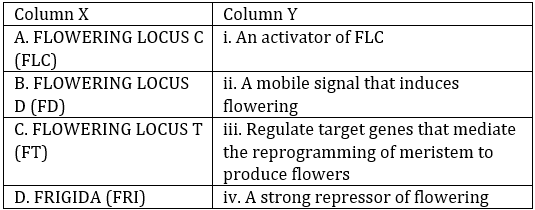
The correct answer is option (d), FLOWERING LOCUS C (FLC). FLC is a key repressor gene that regulates the vernalization requirement in Arabidopsis. Vernalization refers to the process by which plants require a period of cold temperatures to initiate flowering. FLC acts as a flowering repressor and prevents flowering in response to cold exposure. When plants are exposed to low temperatures during winter, the expression of FLC is reduced, thereby allowing the activation of flowering-related genes and facilitating the transition from vegetative to reproductive growth.
In Arabidopsis, FLC represses the expression of flowering genes such as FLOWERING LOCUS T (FT), which is critical for initiating flowering. During vernalization, the prolonged cold treatment leads to epigenetic silencing of FLC, which results in the activation of flowering.
Let's examine the incorrect options:
Option (a): CONSTANS (CO) is involved in regulating flowering in response to photoperiod, not vernalization. It plays a role in promoting flowering under long-day conditions.
Option (b): FLOWERING LOCUS D (FD) is a transcriptional co-activator in the flowering pathway that works with FT to promote flowering, but it is not involved in vernalization.
Option (c): FLOWERING LOCUS T (FT) is a key gene that promotes flowering in response to long-day conditions and interacts with FD. It does not directly regulate vernalization.
Thus, the gene FLC is the main repressor gene responsible for the vernalization requirement in Arabidopsis, making option (d) the correct choice.
Information Booster:
FLOWERING LOCUS C (FLC): FLC is a well-known floral repressor gene in Arabidopsis. It represses flowering by inhibiting the expression of downstream flowering genes. Its expression is significantly reduced after a period of cold temperatures (vernalization), which is essential for the plant to flower in the spring. This cold-induced repression is an epigenetic process, where the chromatin around the FLC gene becomes restructured to silence its expression.
CONSTANS (CO): CO is involved in the photoperiod pathway and promotes flowering in response to day length. It is not directly involved in vernalization but rather in photoperiodic flowering regulation. CO works by activating the expression of FT, which then promotes flowering.
FLOWERING LOCUS D (FD): FD is a bZIP transcription factor that forms a complex with FT to activate the expression of floral meristem identity genes. FD itself is not involved in the vernalization process but is essential for the flowering response to the photoperiod pathway.
FLOWERING LOCUS T (FT): FT is a central gene in the flowering pathway that promotes flowering in Arabidopsis. It is regulated by CO in the photoperiod pathway but does not directly mediate the vernalization response. FT interacts with FD to initiate the flowering process when photoperiod conditions are met.