Correct option is B
Explanation:
The basic exponential growth equation is:
where:
is the rate of Population change over time.
rmaxr_{\text{max}}rmax is the maximum per capita rate of increase (the inherent growth potential of the population).
NNN is the population size.
The logistic growth model describes how a population grows more slowly as it approaches its carrying capacity KKK, which is the maximum population size that the environment can sustain.
The general form of the logistic growth equation is given by:
Where:
NNN = Population size.
KKK = The carrying capacity, i.e., the maximum population that the environment can support.
rmaxNr_{\text{max}} NrmaxN = This term represents the exponential growth part of the equation, similar to the basic exponential model. It describes the population's potential to grow based on its size and the per capita growth rate.
K−NK\frac{K - N}{K}
= This term represents the fraction of the carrying capacity that is still available for growth. When the population is small (N≪KN \ll KN≪K), this fraction is close to 1, meaning the population can grow rapidly. As NNN approaches KKK, the fraction decreases, and the growth rate slows down.When N=KN = KN=K, the fraction =0, meaning the population growth rate
. This indicates that the population has reached its carrying capacity, and there is no further growth.
Key Points:
In the logistic equation, the term represents the fraction of the carrying capacity that is still available for population growth.
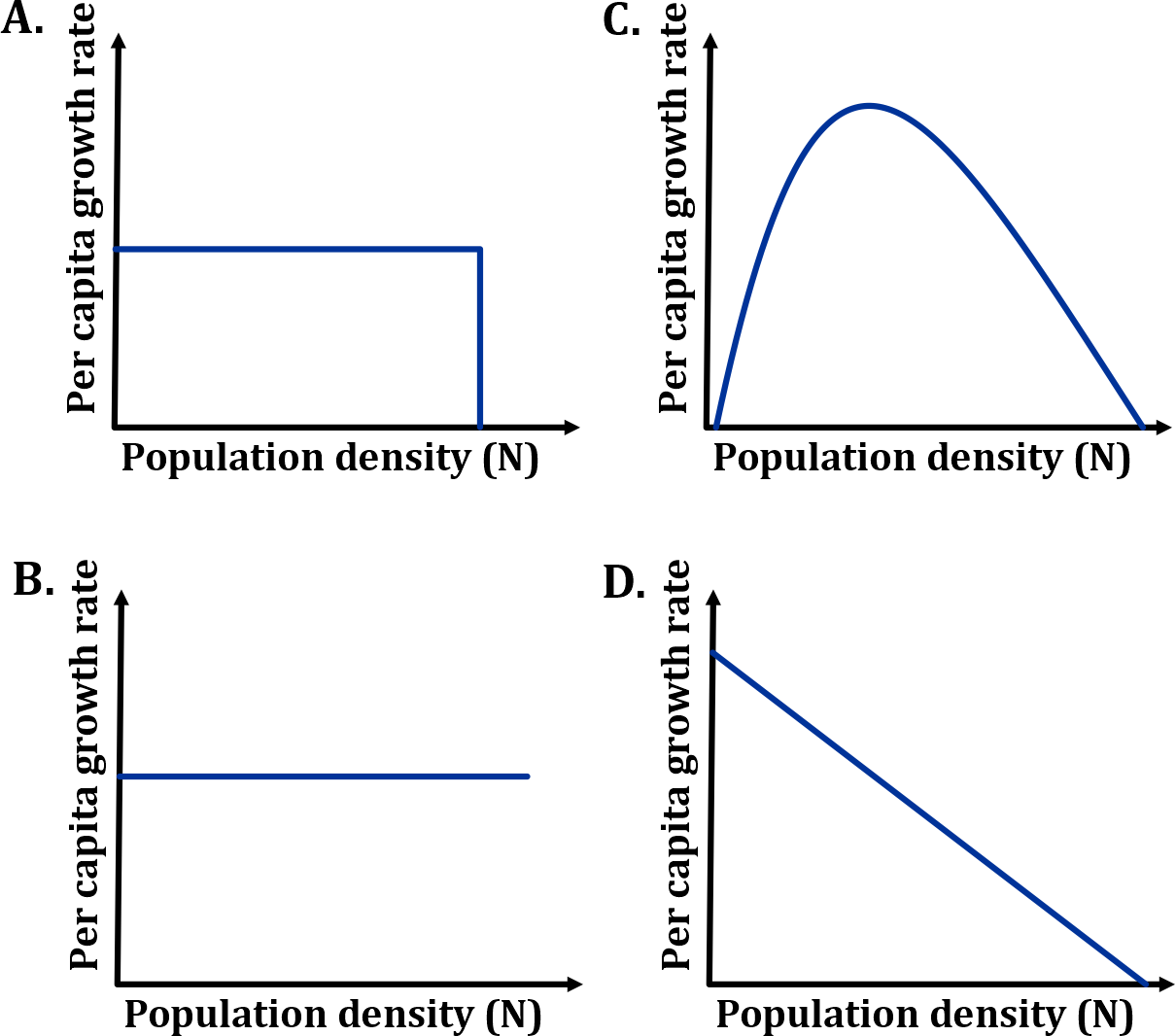
As NNN (population size) gets closer to KKK, the growth rate slows down, eventually reaching zero when N=KN = KN=K.
When NNN is much smaller than KKK, the population grows almost exponentially because is close to 0.
This equation models the sigmoidal (S-shaped) growth curve, where population growth starts slow, accelerates, and then decelerates as it approaches carrying capacity.
Option 2 is correct because it includes the exponential growth component (rmaxN)(r_{\text{max}} N)(rmaxN) seen in unlimited growth models. It introduces a regulating factor that reduces the growth rate as the population approaches the carrying capacity. This factor is crucial for modeling realistic population dynamics where environmental limitations play a role.
Other Options:
Option 1: This option removes the NNN term, meaning it assumes that the growth rate is independent of the current population size, which is incorrect for population models.
Option 3: This option ignores the factor (K-N )meaning it would model exponential growth without any limit, which does not account for the carrying capacity.
Option 4: This is similar to the previous one, with the wrong approach to population growth dynamics. It would lead to exponential growth without considering the carrying capacity.