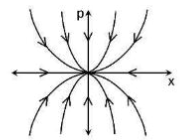
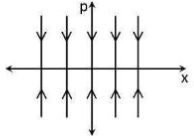
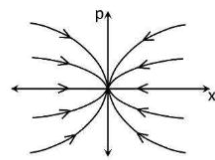
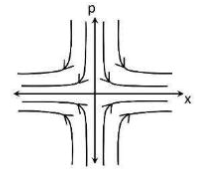
Correct option is A
Given:
- dx/dt = ax,
- dp/dt = -p,
where "a" is a constant, and -1 < a < 0. Determine the trajectory in the (x, p) space.
Solution:
Behavior of x(t):
- The equation dx/dt = ax implies that x changes exponentially over time.
- Since a is negative (-1 < a < 0), x decays exponentially with time, approaching zero as t → ∞.
Behavior of p(t):
- The equation dp/dt = -p describes exponential decay for p as well.
- This means that p(t) also approaches zero as t → ∞.
Coupled dynamics:
- The coupled system implies that as both x and p decay, the relationship between the two will result in trajectories moving directly toward the origin without spiraling.
- Specifically, the trajectories in the (x, p) space will converge directly toward the origin, creating straight lines that represent exponential decay in both variables.
Identify the correct trajectory:
- The correct depiction of this behavior is shown in option (a), where all trajectories point directly toward the origin.
Conclusion:
The correct answer is (a). The trajectories converge directly to the origin without spiraling.