
Correct option is A
Exonuclease is an enzyme that catalyzes the removal of nucleotides from the ends of a DNA molecule. It plays a critical role in DNA repair and replication processes.
Definition
· Exonucleases are enzymes that cleave nucleotides one at a time from the ends of a nucleic acid chain (DNA or RNA).
· They remove nucleotides sequentially, either from the 5' end or the 3' end of the molecule.
Types of Exonucleases:
· 5′ to 3′ Exonuclease:
· Removes nucleotides from the 5' end of a nucleic acid chain.
· Example: DNA polymerase I in prokaryotes (has a 5′ to 3′ exonuclease activity to remove RNA primers).
· 3′ to 5′ Exonuclease:
· Removes nucleotides from the 3' end of a nucleic acid chain.
· Example: DNA polymerase proofreading activity during DNA replication.
Functions:
· Proofreading:
· Corrects errors during DNA replication by removing incorrectly paired nucleotides.
· DNA Repair:
· Removes damaged or mismatched nucleotides during DNA repair processes.
· RNA Processing:
· Trims RNA molecules during maturation (e.g., tRNA and rRNA processing).
· Restriction Enzymes:
· Works in combination with endonucleases to degrade foreign DNA.
Examples of Exonucleases:
· Exonuclease I:
· Removes single-stranded DNA in a 3′ to 5′ direction.
· Exonuclease III:
· Removes nucleotides from the 3′ ends of DNA and is involved in DNA repair.
· Lambda Exonuclease:
· Degrades one strand of double-stranded DNA in the 5′ to 3′ direction.
· RNase D:
· Involved in RNA processing by trimming RNA molecules from the 3' end.
Difference Between Exonucleases and Endonucleases:
· Exonucleases: Work at the ends of nucleic acid chains.
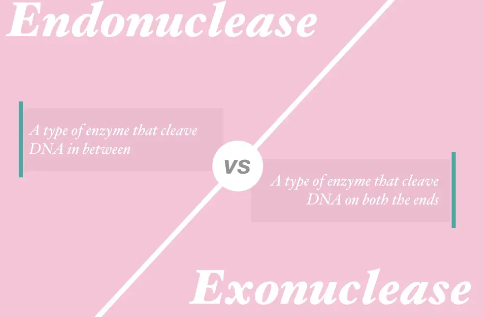
· Endonucleases: Cleave within the nucleic acid chain at specific or random sites.
Applications:
· Molecular Biology:
· Used in cloning to degrade unwanted single-stranded DNA or RNA.
· Genomics:
· In sequencing techniques for processing DNA fragments.
· Gene Editing:
· To remove specific DNA segments in CRISPR-Cas9 studies.
 English
 150 Questions
 150 Marks
 150 Mins


