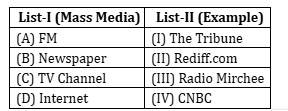
Correct option is B
Harold Innis, a communication theorist, classified communication media into time-based and space-based forms. The chronological order of space-based media can be determined as follows:
1. C. Papyrus: One of the earliest materials for writing, used in ancient Egypt around 3000 BCE, marking the beginning of written communication.
2. D. Paper: Invented in China around 105 CE, paper became a major medium for spreading information over large distances.
3. E. Newspaper: Emerging in the 17th century, newspapers became the first mass medium for public information dissemination.
4. A. Radio: Introduced in the late 19th and early 20th centuries, radio revolutionized communication by enabling real-time audio broadcasts.
5. B. Television: Television, developed in the 1920s and popularized after World War II, became a dominant visual medium for mass communication.
Thus, the chronological sequence is: C (Papyrus) → D (Paper) → E (Newspaper) → A (Radio) → B (Television).
Information Booster:
1. Space-Based Media: Focus on widespread, instantaneous communication over large areas, promoting territorial expansion and control.
2. Papyrus and Paper: Early written materials enabled the storage and distribution of information over time and space.
3. Radio and Television: Modern electronic media facilitated real-time, mass communication across geographic boundaries.
 English
 10 Questions
 20 Marks
 12 Mins