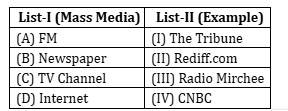
Correct option is C
Television was first introduced in India in 1959 with a pilot project by Doordarshan, then known as All India Radio Television. The primary objective at the initial stage was to educate and create awareness among the rural population, focusing on socio-economic issues like health, family planning, and agricultural practices.
Key Goals of Early Television in India:
Education:
Providing instructional programs for farmers, students, and adults.
Promoting literacy and awareness about hygiene, nutrition, and family welfare.
Awareness:
Broadcasting programs to spread knowledge about national integration, civic responsibilities, and rural development.
Information Booster:
Milestones in Indian Television:
1959: Experimental broadcasts began in Delhi.
1972: Services extended to Mumbai and Amritsar.
1975: Satellite Instructional Television Experiment (SITE) launched to bring educational content to rural India.
1982: Introduction of color television in India during the Asian Games.
Early Focus Areas:
Agricultural innovations (e.g., Green Revolution).
Health and sanitation.
Social reforms like family planning.
Evolution of Television in India:
From education and awareness to news and entertainment in later decades.
The role of Doordarshan evolved significantly with the liberalization of the media sector in the 1990s.
 English
 10 Questions
 20 Marks
 12 Mins