Correct option is D
Explanation-
Option d - Cyanobacteria and Euglenophyta
Cyanobacteria: Photosynthetic prokaryotes (formerly called "blue-green algae"). They reproduce only asexually (binary fission). No known sexual reproduction.
Euglenophyta(e.g., Euglena): Protists with both plant-like and animal-like traits.
Some species show asexual reproduction.
Sexual reproduction is rare, unclear, or absent in most.
So, BSC is NOT applicable here because:
No observable sexual reproduction.
Reproductive isolation can't be assessed.
Other species concepts (like phylogenetic or morphological) are used instead.
Incorrect options-
Option a - Monocots and basal angiosperms
Monocots (like grasses, lilies, orchids) and basal angiosperms (like water lilies) are flowering plants. They reproduce sexually via Flowers, pollen (male gametes) , ovules (female gametes), fertilization and seed formation.
Reproductive isolation can be studied in these plants.
So, BSC is applicable to this group.
Option b - Ascomycetes and Oligochaetes
Ascomycetes: A major group of fungi (includes yeasts, morels, etc.). It can reproduce sexually (via ascospores) and asexually (via conidia). In many species, sexual stages are well understood.
Oligochaetes: Includes earthworms (Annelida). It have sexual reproduction (hermaphrodites with copulation). Mating and reproductive isolation can be tested.
So, BSC is applicable to this group.
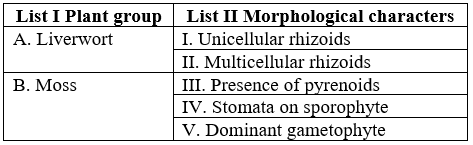
Option c - Mosses and Liverworts
These are bryophytes, early land plants. They have an alternation of generations:
Gametophyte (haploid) is dominant.
Sporophyte (diploid) is dependent.
Sexual reproduction does occur via gametes (antheridia and archegonia). Fertilization is water-dependent but reproductive isolation can be studied.
So, BSC is applicable, although somewhat limited by their reproductive mode.
So, the correct answer is option d – Cyanobacteria and Euglenophyta.
These organisms do not meet the criteria required for the biological species concept to be meaningfully applied.