






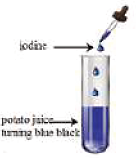
Correct option is C
(c) Potato juice contains starch, which turns blue black with iodine.
The blue-black color in potato juice appears due to the reaction between iodine and starch. When iodine is added to a solution that contains starch, it forms a blue-black complex. This is a characteristic reaction for starch, which is a polysaccharide made up of glucose units. The iodine molecules fit into the helical structure of the starch and form a blue-black color, making it easy to identify starch in the sample.
Important Key Points:
- Starch reacts with iodine to produce a blue-black color, confirming its presence.
- Proteins, fats, and glucose do not show a blue-black reaction with iodine.
- Iodine can be used to test for starch in food samples like potatoes.
- The reaction is a classic test for starch in biology and chemistry.
- Iodine acts as an indicator for starch but not for other macromolecules like proteins or sugars.
- The iodine-starch reaction is used in laboratory experiments to detect starch in various substances.
- Proteins: Proteins are made up of amino acids, and they do not react with iodine to form a blue-black color. They often react with other reagents like Biuret reagent.
- Fats: Fats (lipids) do not interact with iodine in the way starch does. Lipids are usually tested using Sudan III or ethanol for their solubility properties.
- Glucose: While glucose is a sugar and reacts with Benedict's reagent under heating to form a red or orange precipitate, it does not form a blue-black color with iodine.
 English
 100 Questions
 100 Marks
 90 Mins


