hamburger menu
All Coursesall course arrow
adda247
reward-icon
adda247
    arrow
    arrow
    arrow
    Statement I: For Indian thinkers, inference (anumāna) means only a syllogistic inference based on the relation of invariable concomitance between the
    Question

    Given below are two statements:

    Statement I: For Indian thinkers, inference (anumāna) means only a syllogistic inference based on the relation of invariable concomitance between the middle term and the major term.

    Statement II: There should be an absence of the middle term wherever there is an absence of the major term.

    In light of the above statements, choose the correct answer from the options given below:

    A.

    Both Statement I and Statement II are true

    B.

    Both Statement I and Statement II are false

    C.

    Statement I is true but Statement II is false

    D.

    Statement I is false but Statement II is true

    Correct option is A

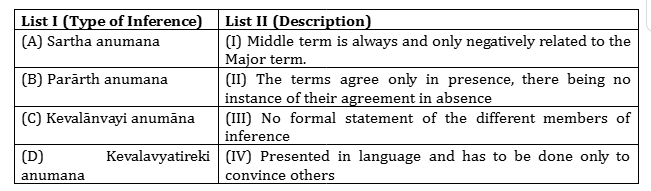
    Statement I is true because Indian logic, particularly Nyaya philosophy, defines inference (anumāna) as a syllogistic reasoning process based on the relation of invariable concomitance (vyāpti) between the middle term (hetu) and the major term (sādhya). Statement II is also true because, according to the rule of vyatireka (negative concomitance), the absence of the middle term implies the absence of the major term.
    Information Booster: 1. Anumāna: In Indian logic, it refers to reasoning through inference based on the observed connection between the middle and major terms.
    2. Vyāpti: The invariable concomitance between the middle and major terms, ensuring valid inference.
    3. Syllogism: A form of reasoning that consists of premises leading to a conclusion.
    4. Hetu (Middle Term): Connects the subject and predicate in a logical argument.
    5. Vyatireka Anumāna: Negative inference, stating that if the middle term is absent, the major term must also be absent.
    6. Indian Philosophy: Focuses heavily on structured reasoning and logical inference to support philosophical conclusions.
    7. Indian logic adds depth to the understanding of cause-effect relationships and their role in reasoning.

    Free Tests

    Free
    Must Attempt

    Basics of Education: Pedagogy, Andragogy, and Hutagogy

    languageIcon English
    • pdpQsnIcon10 Questions
    • pdpsheetsIcon20 Marks
    • timerIcon12 Mins
    languageIcon English
    Free
    Must Attempt

    UGC NET Paper 1 Mock Test 1

    languageIcon English
    • pdpQsnIcon50 Questions
    • pdpsheetsIcon100 Marks
    • timerIcon60 Mins
    languageIcon English
    Free
    Must Attempt

    Basics of Education: Pedagogy, Andragogy, and Hutagogy

    languageIcon English
    • pdpQsnIcon10 Questions
    • pdpsheetsIcon20 Marks
    • timerIcon12 Mins
    languageIcon English

    Similar Questions

    test-prime-package

    Access ‘UGC NET December’ Mock Tests with

    • 60000+ Mocks and Previous Year Papers
    • Unlimited Re-Attempts
    • Personalised Report Card
    • 500% Refund on Final Selection
    • Largest Community
    students-icon
    354k+ students have already unlocked exclusive benefits with Test Prime!
    Our Plans
    Monthsup-arrow