Correct option is C
The correct matches are:
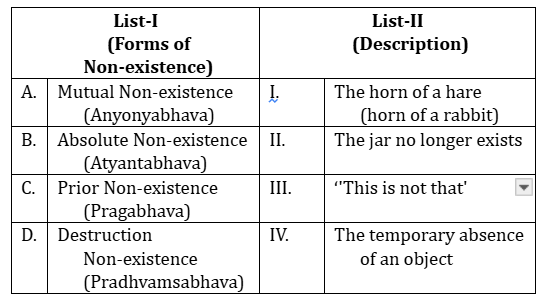
· A. Mutual Non-existence (Anyonyabhava) – III. ‘This is not that': This form of non-existence refers to the mutual exclusion between two things, where one thing is not another.
· B. Absolute Non-existence (Atyantabhava) – I. The horn of a hare (horn of a rabbit): This is an example of absolute non-existence, where something does not exist in any form, such as the horn of a hare, which is a non-existent entity.
· C. Prior Non-existence (Pragabhava) – IV. The temporary absence of an object: Prior non-existence refers to the absence of something before it comes into being, like the absence of a jar before it is made.
· D. Destruction Non-existence (Pradhvamsabhava) – II. The jar no longer exists: Destruction non-existence refers to something that existed before but has now ceased to exist, such as a broken jar.
Information booster:
1. Mutual Non-existence emphasizes the distinctness or difference between two entities (e.g., a jar is not a cloth).
2. Absolute Non-existence refers to something that is impossible and can never exist (e.g., the horn of a rabbit).
3. Prior Non-existence occurs before an object comes into being (e.g., the absence of a house before it is built).
4. Destruction Non-existence happens when an object that existed is destroyed or ceases to exist.
 English
 10 Questions
 20 Marks
 12 Mins