Correct option is C
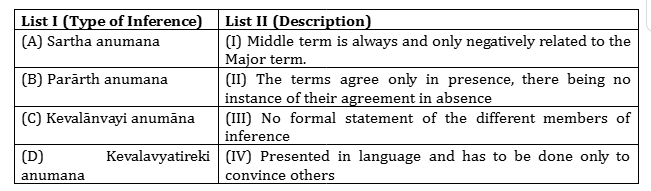
Sārtha Anumāna (A)-(III): Sārtha Anumāna is the inference process without formal statements. It refers to a simple reasoning process and does not include explicit elaboration of terms like the middle, major, or minor terms.
Parārth Anumāna (B)-(IV): Parārth Anumāna involves inference presented in language to convince others. It explicitly states all steps in the reasoning to ensure the listener or reader follows the logical process.
Kevalānvayi Anumāna (C)-(II): This type of inference agrees only in presence. It relies entirely on positive correlations, where there is no instance of disagreement or negation between terms.
Kevalavyatireki Anumāna (D)-(I): In this inference, the middle term is only negatively related to the major term, relying on negative instances to establish the relationship.
Information Booster: 1.
Sārtha Anumāna: Used for self-convincing and informal reasoning.
2.
Parārth Anumāna: Used to explain or convince others, especially in formal contexts.
3.
Kevalānvayi Anumāna: Relies solely on positive instances (e.g., universal affirmatives).
4.
Kevalavyatireki Anumāna: Operates on the basis of elimination or negation.
5.
Anumāna (Inference): A central concept in Indian logic, especially in Nyaya philosophy.
 English
 10 Questions
 20 Marks
 12 Mins