






Correct option is B
The standard deviation of a sampling distribution is commonly referred to as the sampling error. This term represents the variability of a statistic (e.g., the mean) calculated from a sample, as opposed to the entire population. Sampling error occurs because a sample is only a subset of the population, and thus, it is unlikely to perfectly represent the population characteristics.
For example, if you repeatedly draw random samples from a population and compute the mean for each sample, the standard deviation of those sample means is the sampling error. It quantifies the degree of variation or inconsistency expected when using sample statistics to estimate population parameters.
Information Booster
The sampling error is mathematically represented as:
Sampling Error (Standard Error)
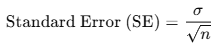
Where:
σ\sigma is the population standard deviation.
n is the sample size.
A smaller sampling error indicates that the sample statistic is closer to the true population parameter. Increasing the sample size reduces the sampling error, improving the reliability of sample estimates.
Additional Knowledge
Parameter: A parameter is a fixed numerical value that describes a characteristic of a population, such as the population mean (μ\mu) or standard deviation (σ\sigma). Unlike sampling error, a parameter does not fluctuate because it represents the entire population.
External Validity: External validity refers to the extent to which the results of a study can be generalized to other contexts, populations, or settings. It is not related to the calculation of the standard deviation of a sampling distribution.
Symmetry Estimation: Symmetry estimation is used in statistics to assess whether a data distribution is symmetric around a central value. It does not measure variability in sampling distributions.
 English
 10 Questions
 20 Marks
 12 Mins


