






Correct option is C
(A) Coefficient of Dispersion → (III) Variance in terms of mean
The coefficient of dispersion is a relative measure of variability, expressing variance in terms of the mean rather than absolute values.
Formula: Coefficient of Dispersion=varance/mean
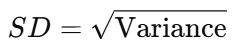
(B) Standard Deviation → (IV) Positive square root of variance
Standard deviation (SD) measures the dispersion of data around the mean.
It is the square root of variance:
(C) Coefficient of Variation → (I) Standard deviation as a percentage of mean
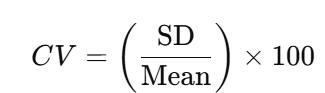
The coefficient of variation (CV) expresses the standard deviation as a percentage of the mean, allowing comparison across datasets.
Formula:
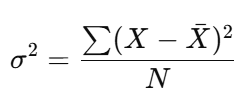
(D) Variance → (II) Mean of squared deviations of individual scores from mean
Variance measures the spread of data points around the mean, calculated as the mean of squared deviations:
Thus, the correct answer is Option (3): (A)-(III), (B)-(IV), (C)-(I), (D)-(II).
 English
 10 Questions
 20 Marks
 12 Mins


