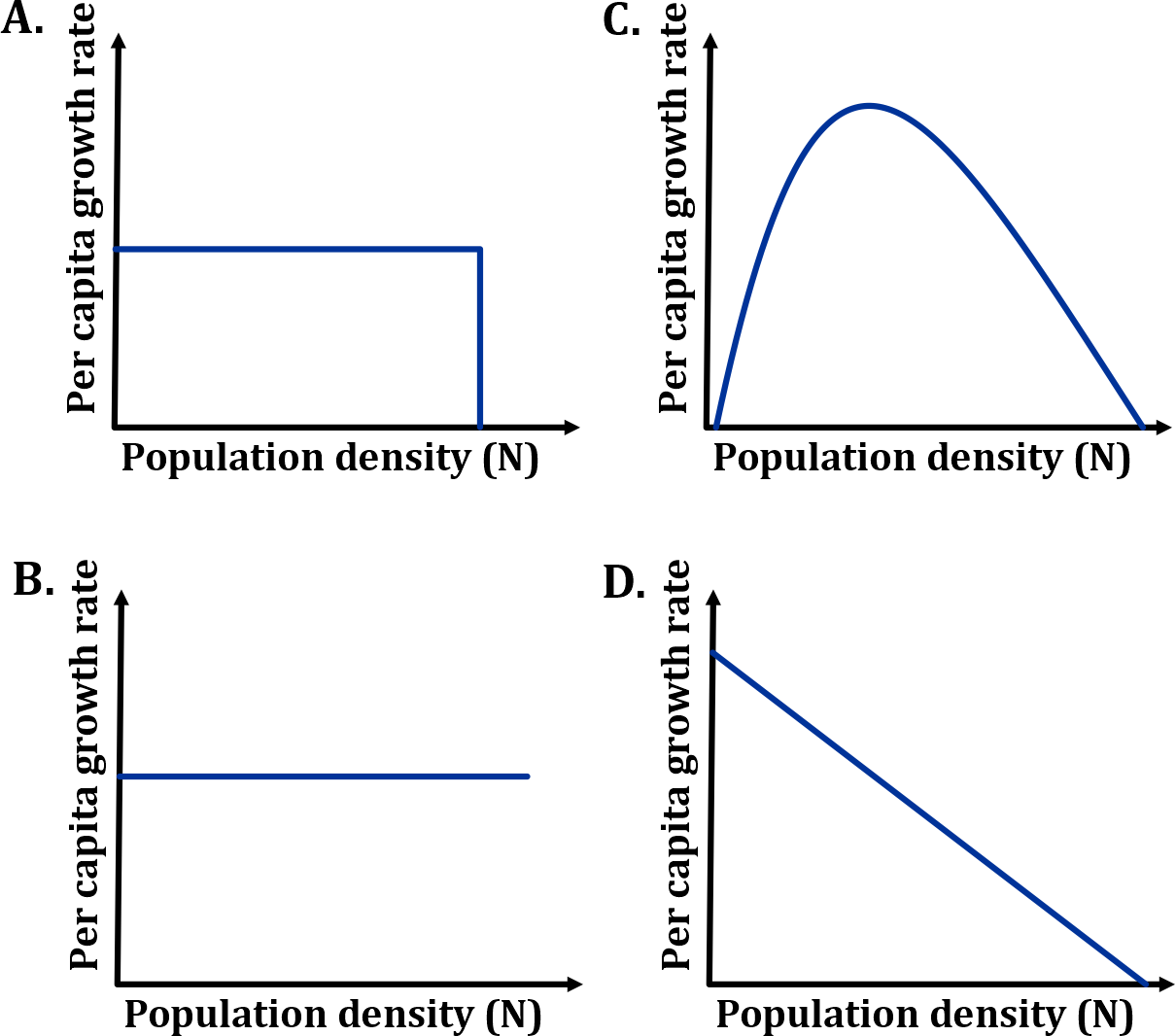
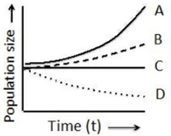
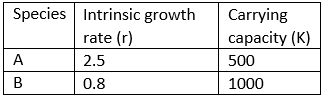
Correct option is D
The correct answer is: A, B, C, and E only
Explanation:
The question refers to r-selection and K-selection strategies, which are life history strategies that describe how species allocate energy towards survival, growth, and reproduction. Let's evaluate each statement:
A. Maximum rate of increase of a population:
This is characteristic of r-selection. r-selected species are typically characterized by a high reproductive rate, many offspring, and rapid population growth in unstable environments. Thus, A is correct.
B. Density of individuals supported by the environment at equilibrium:
This statement refers to K-selection. K-selected species are adapted to stable environments and have fewer offspring with more investment in their care, leading to a stable population size near the carrying capacity of the environment. Hence, B is correct.
C. Life history evolution:
Life history evolution is a fundamental concept in both r-selection and K-selection strategies. These strategies describe how species evolve in terms of their reproductive strategies, timing of reproduction, and investment in offspring. Hence, C is correct.
D. Liebig’s law of the minimum:
While Liebig's law of the minimum is an important ecological concept that explains how the growth of organisms is limited by the most limiting factor, it is not directly related to the r- and K-selection strategies. Therefore, D is not correct.
E. Precoecity and altriciality:
Precoecity (early maturation) and altriciality (dependence on parental care) are terms that are typically linked to r- and K-selection species. r-selected species often have precocial offspring, which are more independent, while K-selected species tend to have altricial offspring, which are more dependent on parental care. Hence, E is correct.
Information Booster:
r-selection species are characterized by rapid reproduction, high reproductive rates, and little parental care, typically found in unstable environments.
K-selection species are characterized by fewer offspring, longer life spans, and greater parental care, thriving in stable environments with limited resources.
Life history evolution in both r and K strategies affects how species allocate energy to growth, reproduction, and survival.
Precoecity refers to early maturation, typical in r-selected species, while altriciality refers to young being more dependent on parents, common in K-selected species.