






Correct option is B
Solution:
Five villages: A, B, C, D, and E
Post offices: 2
Schools: 2
Accessible by road: 3
Population more than 5000: 2
Population between 2000 and 5000: 2
Population less than 2000: 1
A is accessible by road.
B has a population of more than 5000.
As the population of B is > 5000, we put for the cells of 2000-5000 and < 2000.
D has a school and is accessible by road but does not have a post office.
E has a school but is not accessible by road.
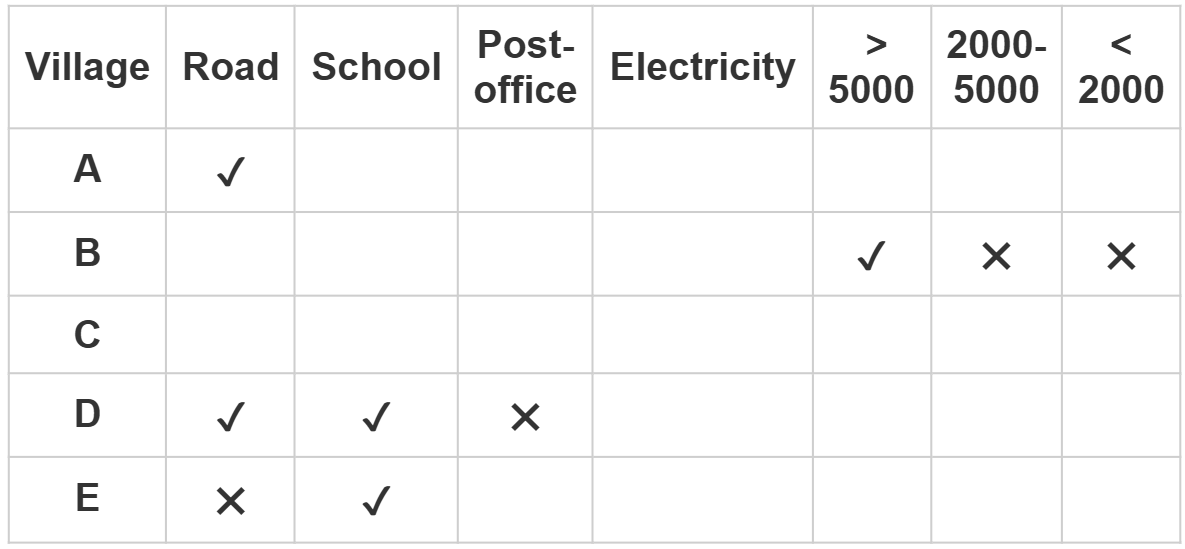
Each of the villages with population more than 5000 has a school.
Therefore, B will have a school.
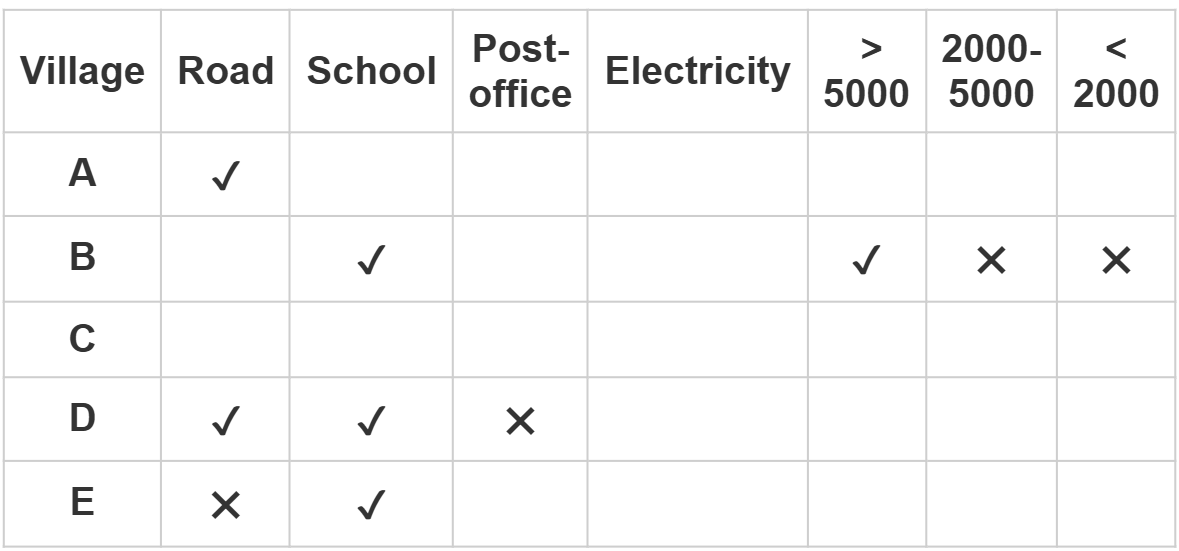
Three villages have schools.
So, only B, D, and E have schools. We put for the remaining.
Two of these villages have electricity in addition to certain other facilities such as school and accessibility by road.
Three villages are accessible by road.
So, only B and D have electricity along with school and accesibility by road.
One village with a population of less than 2000 also has a school but neither has a post office nor is accessible by road.
Among C and E, only E has school without accessibility by road. So, E has population < 2000.
Of the two villages having a population between 2000 and 5000 only one has a post office and is accessible by road.
Two villages have post offices.
Here, only A is left with a population between 2000 and 5000 and accessibility by road.
Each of the villages with population more than 5000 has a school.
Two villages have more than 5000 population.
So, D has population > 5000 and C has population between 2000 and 5000.
Of the two villages having a population between 2000 and 5000 only one has a post office and is accessible by road.
So, C does not have a post-office.
· Two villages have post offices.
· So, B has post-office.
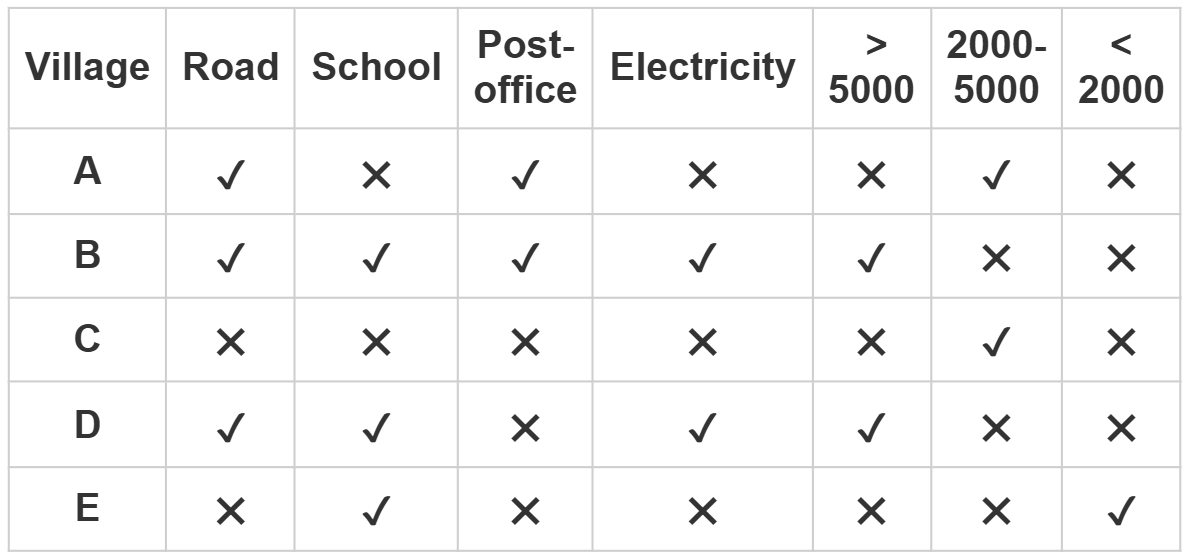
Hence, village C does not have any of the facilities available to other villages
 English
 100 Questions
 200 Marks
 60 Mins


