Correct option is C
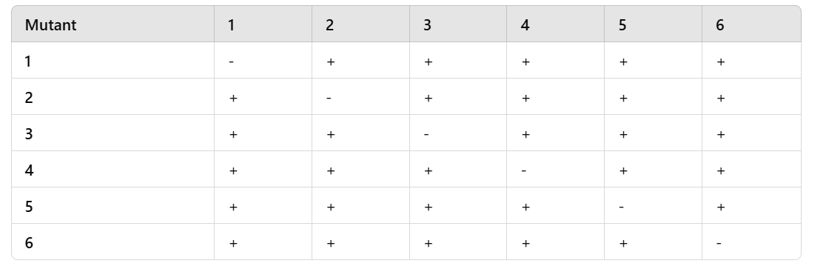
A complementation group consists of mutants that fail to complement each other, meaning they are defective in the same gene.
- Identify Patterns in the Table:
- If a mutant does not complement another, they belong to the same gene.
- If a mutant complements another ("+" result), they belong to different genes.
- Analyzing the Table:
- Each mutant complements all other mutants, except itself.
- This suggests that each mutant represents a separate gene.
- However, if there were six genes, we would expect at least one case where a mutant does not complement another.
- Since one pair of mutants shares the same gene, we conclude there are five distinct genes.
- The six mutants fall into five complementation groups (meaningfive genesare involved in pyocyanin biosynthesis).
- The correct answer is: (c) Five Genes
Information booster :
1. Complementation tests help identify the number of genes involved in a biosynthetic pathway.
2. If two mutants do not complement each other (- result), they belong to the same gene.
3. If two mutants complement each other (+ result), they belong to different genes.
4. Since five unique complementation groups exist, five genes control pyocyanin production.
5.Understanding genetic pathways through complementation analysis is crucial for metabolic and molecular biology studies.
Additional Knowledge:
- Complementation analysis is widely used in genetics and molecular biology to identify the number of genes involved in a process.
- This type of experiment is commonly used for studying biosynthetic pathways, genetic disorders, and functional genomics.