Correct option is C
The correct answer is: (3) T-square method
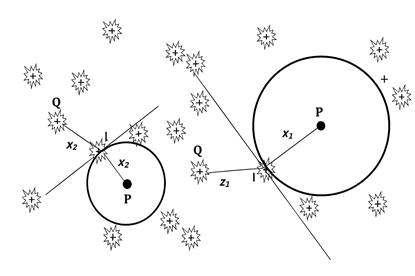
Explanation :Upon reviewing the image more carefully, the technique depicted corresponds to the T-square method. This method is a plotless sampling technique used in plant ecology to estimate plant density. The T-square method involves using two perpendicular lines that intersect at the sampling point (P). The distances from the sampling point (P) to various plants are measured along these lines, usually to the nearest plants in each of the four quadrants formed by the intersecting lines.
In the T-square method, two lines intersect at the sampling point (P), and distances to the nearest plants along these lines are measured to calculate density.
The process involves selecting random points and measuring the distances to the nearest plants within predefined sectors.
The quadrants formed by the intersecting lines are used to divide the area and estimate the number of plants.
This method is especially useful in estimating plant density when the plants are scattered and you need a rapid assessment.
Information Booster:
The T-square method divides the area into four quadrants using two perpendicular lines that intersect at the sampling point.
It is a plotless sampling technique, which makes it more efficient than using large, predefined plots.
The main goal is to estimate plant density by measuring the distance to the nearest plant in each of the quadrants formed by the T-shaped lines.
The T-square method is well-suited for random plant distributions and is easy to implement.
This method is commonly used when studying vegetation in larger areas where defining fixed plots may be cumbersome.
The distances to plants in each quadrant are then used to estimate the overall density of plants in the area.
Additional Information:
Point-centered quarter method divides the area into four quadrants based on a central sampling point, with measurements taken from the center to the nearest plant in each quadrant. It is different from the T-square method because it uses perpendicular lines but not a central point with radial measurements.
Wandering-quarter method involves selecting random points without specific quadrants, and it doesn’t use the intersecting lines to define the quadrants as the T-square method does.
Basic distance sampling method generally involves using transects and measuring distances to plants along the transects, which is different from the quadrant-based system of the T-square method.