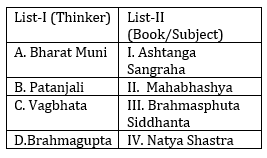
Correct option is A
Nalanda University, established during the Gupta Empire in ancient India, was a renowned center for Buddhist learning. It attracted scholars and students from different parts of the world, particularly from countries such as China, Korea, Japan, Tibet, Mongolia, Sri Lanka, and Southeast Asia. The university was famous for its study and teaching of Buddhist philosophy, scriptures, and practices.
Information Booster:
- Buddhist learning at Nalanda was central to the university's curriculum, with subjects including Buddhist logic, philosophy, and medicine.
- The university also housed texts on various other subjects like mathematics, astronomy, and political science, but it was primarily known for its focus on Buddhism.
- Nalanda attracted great scholars like Xuanzang (Hiuen Tsang) from China, who studied and wrote extensively about the university.
- The establishment of Nalanda marked an important phase in the development of Buddhist monastic education and learning in India.
- Buddhist monks and scholars were an integral part of the university, which played a key role in spreading Buddhist teachings across Asia.
Additional Knowledge:
- Brahminical learning primarily refers to the study of Hindu scriptures like the Vedas and Upanishads, which were prominent in other ancient Indian educational institutions.
- Kshatriya learning would be more associated with martial, political, and leadership education, often seen in specialized schools for warriors and rulers.
- Jain learning would focus on the teachings of Jainism, another ancient Indian religion, and would have been taught at institutions like Shravanabelagola or other Jain centers, but Nalanda was not primarily focused on Jain learning.
 English
 10 Questions
 20 Marks
 12 Mins