Correct option is A
In computer graphics, different geometric transformations are characterized by specific parameters or effects on an object.
A pivot point is the reference point about which an object is turned, making it associated with rotation.
A fixed point is commonly used as the reference point for scaling, where the object expands or contracts while that point remains stationary.
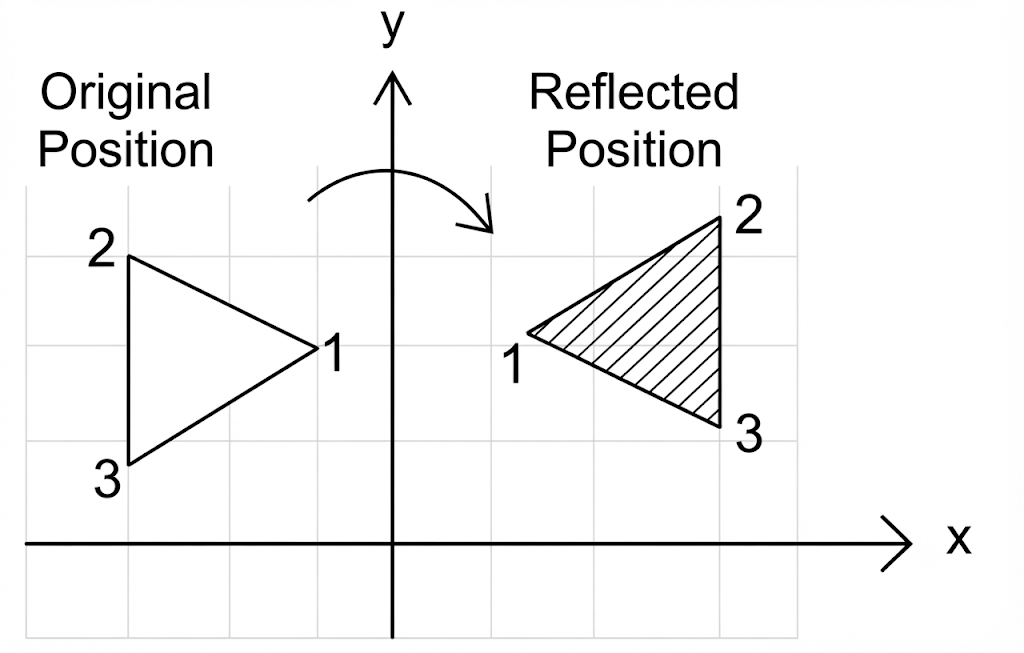
A mirror image is produced through reflection, which reverses the object's orientation about a reflection axis or plane.
Distortion changes the shape of an object by displacing its coordinates and shearing is a common transformation that produces such a slanted or distorted appearance.
Information Booster
1. Pivot Point → Rotation
· A rotation transformation turns an object through a specified angle about a reference point called the pivot point.
· In 2D graphics, rotation about the origin is represented by:
· For rotation about an arbitrary pivot, the object is translated so that the pivot becomes the origin, rotated and then translated back.
· Applications include object orientation, animation and image manipulation.
2. Fixed Point → Scaling
· Scaling changes the size of an object along one or more coordinate directions.
· A fixed/reference point can be maintained while scaling an object around it.
· For scaling about the origin:
· If the transformation is uniform scaling.
· If it produces non-uniform scaling.
3. Mirror Image → Reflection
· Reflection produces the mirror image of an object with respect to a line in 2D or a plane in 3D.
· Reflection reverses the orientation of the object.
· For reflection about the x-axis:
(x, y) → (x, −y)
· For reflection about the y-axis:
(x, y) → (−x, y)
· It is widely used in symmetry operations and image processing.
4. Distortion → Shear
· Shearing changes the shape or orientation of an object by shifting coordinates in one direction in proportion to another coordinate.
· For x-direction shear:
· Parallel lines generally remain parallel, but angles and shapes can change.
· Shearing is used for effects such as slanting text and geometric distortion.
5. Transformation Matrix Representation
· 2D geometric transformations can conveniently be represented using homogeneous coordinates.
· Translation, rotation, scaling, reflection and shearing can be represented using matrices.
· Multiple transformations can be combined through matrix multiplication.
 English
 10 Questions
 20 Marks
 12 Mins