Correct option is D
Statement I: The maximum number of sides that a triangle might have when clipped to a rectangular viewport is
6.
This statement is
false. When a triangle is clipped to a rectangular viewport, it can be broken into
a polygon with up to 7 sides, depending on how the triangle intersects the viewport edges. For example, if all three sides of the triangle intersect the edges of the viewport, the resulting polygon may have up to 7 sides.
To illustrate why the maximum number of sides can exceed 6, consider the following scenario:
1. A triangle intersects all four edges of the rectangular viewport.
2. Each edge contributes additional vertices to the clipped polygon.
3. The resulting polygon can have up to
7 sides if the triangle passes through all edges without being completely inside or outside the viewport.
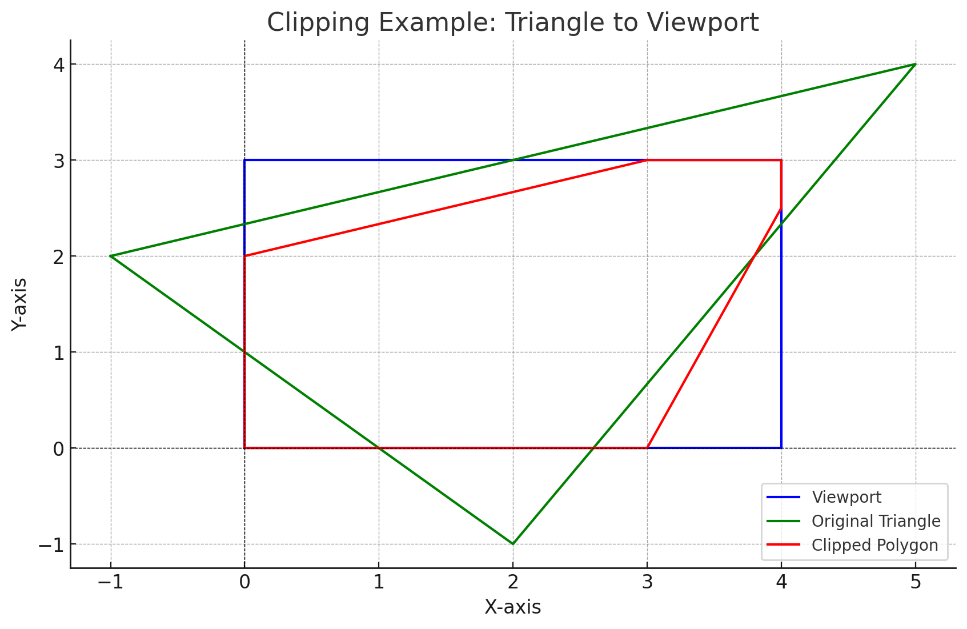
The figure above demonstrates the clipping of a triangle to a rectangular viewport. The original triangle (green) intersects the viewport edges, resulting in a clipped polygon (red) with
7 sides, proving that the maximum number of sides can exceed 6.
Statement II: In 3D graphics, the perspective transformation is nonlinear in z.
This statement is
true. Perspective projection involves dividing by the depth (z), which introduces a nonlinear relationship in the transformed coordinates. This transformation is crucial for simulating depth perception in 3D rendering.
Information Booster:
1.
Clipping a Triangle:
· When a triangle is clipped by a rectangular viewport, the edges of the triangle may intersect the viewport edges.
· In the worst-case scenario, the triangle can be split into a polygon with
7 sides after clipping.
· This occurs when each edge of the triangle intersects two sides of the viewport.
2.
Types of Clipping Algorithms:
·
Cohen-Sutherland Algorithm: Efficient for line clipping.
·
Sutherland-Hodgman Algorithm: Commonly used for polygon clipping.
·
Weiler-Atherton Algorithm: Handles complex polygon clipping, including holes.
3.
Perspective Transformation:
· Perspective projections map 3D objects onto a 2D plane by dividing coordinates by the depth z, creating a realistic depth effect.
· The transformation is nonlinear in zzz, which means straight lines in 3D can appear curved after the projection.
4.
Applications of Clipping and Perspective Transformation:
· Used in computer graphics for rendering scenes.
· Essential for viewports in graphical user interfaces.
Additional Knowledge:
·
Why Statement I is false? The statement underestimates the complexity of clipping algorithms, which can result in polygons with
more than 6 sides depending on the triangle's position relative to the viewport.
·
Perspective Transformation Nonlinearity: It uses the formula:

 English
 10 Questions
 20 Marks
 12 Mins