






Correct option is B
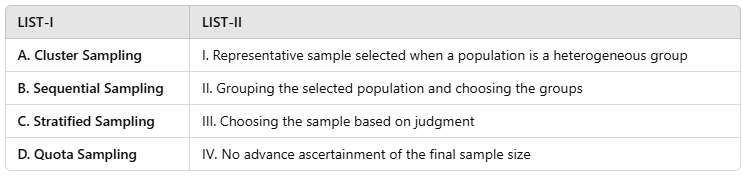
The correct matching of sampling methods with their descriptions is:
·
A. Cluster Sampling: This method involves grouping the population into clusters and then selecting whole clusters for sampling. It is particularly useful when the population is spread over a large area. The correct match is
II. Grouping the selected population and choosing the groups.
·
B. Sequential Sampling: This method involves
sampling sequentially and does not determine the final sample size in advance. The correct match is
IV. No advance ascertainment of the final sample size.
·
C. Stratified Sampling: This method involves dividing the population into subgroups (strata) that share similar characteristics, and then taking a representative sample from each stratum. The correct match is
I. Representative sample selected when a population is a heterogeneous group.
·
D. Quota Sampling: This non-probability sampling method involves selecting samples based on the judgment of the researcher, where the sample is chosen to meet a pre-determined quota for specific characteristics. The correct match is
III. Choosing the sample based on judgment.
Information Booster:
·
Cluster Sampling: Useful for large, geographically dispersed populations. Clusters are chosen randomly, and then all or a random sample from within these clusters is selected.
·
Sequential Sampling: Often used in situations where sample sizes are not fixed initially, and sampling continues until a pre-determined result is achieved.
·
Stratified Sampling: Ensures that every subgroup (stratum) within a population is proportionately represented, providing a more accurate reflection of the entire population.
·
Quota Sampling: A non-random method where researchers select specific numbers of participants from each subgroup, based on the researcher's judgment or convenience.
 English
 10 Questions
 20 Marks
 12 Mins


