Correct option is C
Let’s analyze the options based on their relationship with descriptive study designs:
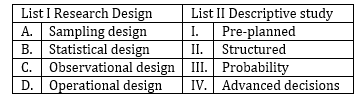
· A. Sampling Design (III): Refers to the method used for selecting a representative sample from the population. In descriptive studies, this often involves probability sampling to ensure generalizability.
· B. Statistical Design (I): Deals with the statistical methods and techniques pre-planned for data analysis. These are crucial for interpreting data meaningfully.
· C. Observational Design (II): Involves structured observation, where the researcher systematically observes and records behaviors or events.
· D. Operational Design (IV): Focuses on advanced decisions regarding the implementation of the research plan, ensuring that the procedures are practical and efficient.
Correct Matching: · A-III: Sampling Design → Probability
· B-I: Statistical Design → Pre-planned
· C-II: Observational Design → Structured
· D-IV: Operational Design → Advanced decisions
Correct Answer:
(c) A-III, B-I, C-II, D-IV Information Booster: 1. Sampling Design: Ensures that the sample represents the population effectively, especially critical in descriptive studies.
2. Statistical Design: Pre-determines the analysis techniques to ensure robust data interpretation.
3. Observational Design: Focuses on structured methodologies for collecting observable data.
4. Operational Design: Translates the research design into actionable steps, minimizing logistical challenges.
Additional Information: · Descriptive Research: Aims to systematically describe a phenomenon without manipulating variables.
· Types of descriptive studies include cross-sectional studies, observational studies, and case studies.
 English
 150 Questions
 150 Marks
 150 Mins