






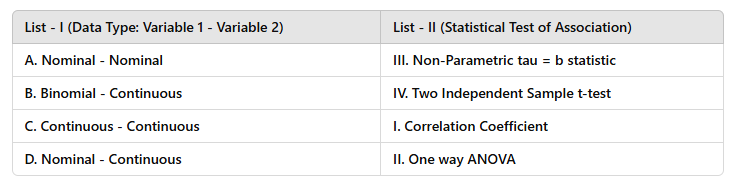
Correct option is B
1.
A. Nominal - Nominal → III. Non-Parametric tau = b statistic
· Used to measure the association between two nominal variables.
2.
B. Binomial - Continuous → IV. Two Independent Sample t-test
· Suitable for comparing means between two groups (binomial) with a continuous outcome.
3.
C. Continuous - Continuous → I. Correlation Coefficient
· Measures the strength and direction of the relationship between two continuous variables.
4.
D. Nominal - Continuous → II. One way ANOVA
· Used to compare means across multiple groups (nominal categories) with a continuous outcome.
Information Booster:
1.
Correlation Coefficient (I): Measures the degree to which two continuous variables move in relation to each other (e.g., Pearson's correlation).
2.
Two Independent Sample t-test (IV): Used to determine if there are statistically significant differences between the means of two independent groups.
3.
Non-Parametric tau = b statistic (III): A statistical test for measuring the association between two ordinal or nominal variables.
4.
One way ANOVA (II): Used for comparing the means of three or more independent groups based on one independent nominal variable.
Additional Knowledge:
·
Nominal Data: Represents categories with no specific order (e.g., gender, colors).
·
Binomial Data: Data with two possible outcomes (e.g., yes/no, pass/fail).
·
Continuous Data: Numeric data that can take any value within a range (e.g., height, weight).
·
Statistical Tests:
·
Correlation Coefficient: Measures linear relationships between continuous variables.
·
t-test: Compares means between two groups.
·
ANOVA: Compares means across multiple groups.
·
Non-Parametric Tests: Used when data doesn't meet assumptions required for parametric tests.
 English
 10 Questions
 20 Marks
 12 Mins


