






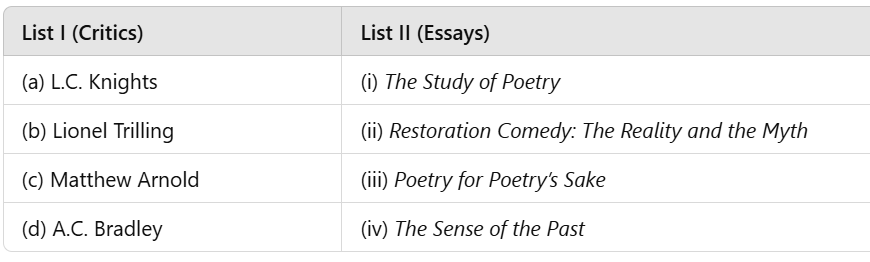
Correct option is C
Explanation:
L.C. Knights → Restoration Comedy: The Reality and the Myth
L.C. Knights critiqued the realism and ideals of Restoration comedy in this essay.
Lionel Trilling → The Sense of the Past
Trilling’s exploration into literary and cultural criticism is reflected in this essay.
Matthew Arnold → The Study of Poetry
Arnold’s essay defines poetry as a criticism of life and evaluates the role of poetry in society.
A.C. Bradley → Poetry for Poetry’s Sake
Bradley focuses on the intrinsic beauty and purpose of poetry without external influences.
Information Booster:
L.C. Knights: Known for his critique of Shakespeare and Restoration literature.
Lionel Trilling: A notable cultural critic with works emphasizing the moral and aesthetic elements of literature. 'The sense of the past', is an important critique of Trilling. In this work he asserts that all literature must depict a historical study as literature is a historical art. According to Trilling a poet by himself is a historian, a reliable chronicler of events. A literary work has to be aware of its past. The past of a work of literature lends to it its aesthetic authority. Literature is important to us and will always remain so.
Matthew Arnold: An advocate of using poetry to reflect and critique life; key figure in Victorian criticism. Arnold's main focus in this work is the "high destiny" of poetry; he thinks that as science and philosophy inevitably reveal to be weak and unstable, "mankind will discover that we have to turn to poetry to interpret life for us, to console us, to sustain us." In order to avoid the mistake of placing an excessive amount of value on some poems (and poets), Arnold's essay focuses on articulating a "high standard" and "strict judgment." It also lays out a method for selecting only the best and thus "classic" poets (as opposed to the description of writers of the ancient world). The excerpts from Milton, Shakespeare, Dante, and Homer—some of Arnold's classic poets—are meant to demonstrate how ageless and poignant their poetry is. For Arnold, sincerity and emotion are crucial, as is the gravity of the subject: "The superiority of diction and movement marking its style and manner is inseparable from the superior character of truth and seriousness, in the matter and substance of the best poetry." Geoffrey Chaucer, who, according to Arnold, ultimately lacks the "high seriousness" of classic poets, is an example of an indispensable poet who does not meet the criteria for being considered "classic." Arnold's aim to shed light on and preserve the poets he considers to be the foundation of literature, as well as to raise ethical concerns about poetry that does not support truth, beauty, bravery, and clarity, are at the heart of his argument. The reasoning behind the essay is Arnold's conviction that poetry should comfort and encourage.
A.C. Bradley: Poetry for Poetry's Sake, An introductory lecture on the nature and worth of poetry that was given in 1901, early in the 20th century. It focused on the notion that poetry is an art form with inherent value that should be valued for its own sake rather than for any external purposes it may have, like moral instruction or emotional manipulation. Bradley addresses the subject of poetic worth, stressing the significance of appreciating poetry in its most basic form, which blends form and content. Bradley argues that poetry should be viewed as a separate work of art, regardless of the ideas or messages it expresses that go beyond its creative creation. He addresses frequent misconceptions regarding the relationship between form and content throughout his speech, contending that poetry loses its artistic integrity when it is reduced to external meanings or technicalities. According to his theory, the poem's poetic worth is found in its unity of language and meaning rather than in the various parts that make it up. Bradley demonstrates the unique character of poetic experience and its crucial role in human society by delving into the intricacies of how poetry engages with life, experience, and emotion.
 English
 10 Questions
 20 Marks
 12 Mins


