






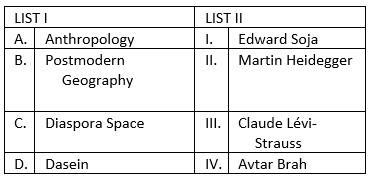
Correct option is C
1. "Anthropology" — Claude Lévi-Strauss
Claude Lévi-Strauss, a prominent French anthropologist, is known for his groundbreaking work in structural anthropology. In "Anthropology," he explores the study of human societies and cultures through a structural lens, emphasizing the underlying patterns and systems that shape human behavior and beliefs.
Key Idea: Founder of structural anthropology.
Approach: Applies structural linguistics (inspired by Saussure) to anthropology — studying myths, kinship systems, and rituals as structures of meaning.
Core Insight: Beneath the diversity of human cultures lie universal patterns of thought (binary oppositions like raw/cooked, nature/culture).
Literary/Cultural Link: Influenced structuralist literary theory — especially analysis of myths and narratives (e.g., Barthes, Todorov).
2. "Postmodern Geography" — Edward Soja
Edward Soja's "Postmodern Geography" is a significant work in human geography. It delves into the impact of postmodernism on the field, examining how shifts in cultural, economic, and social paradigms have influenced the way we perceive and interact with space and place in a rapidly changing world.
Key Idea: Introduces postmodern spatial theory.
Approach: Examines how space is socially produced and culturally interpreted, moving beyond geography as mere physical mapping.
Core Concept:Space is not neutral — it’s shaped by power, culture, and history.
Thirdspace — a lived space that merges real and imagined geographies.
Literary/Cultural Link: Connects with postmodern literature's concern with fragmented, multi-layered settings and urban narratives.
3. "Diaspora Space" — Avtar Brah
Avtar Brah's "Diaspora Space" is a key text in the study of diaspora and migration. The book explores the complex experiences of diasporic communities and the spaces they inhabit, shedding light on issues of identity, belonging, and the transnational connections that define the modern diasporic experience.
Key Idea: From her book Cartographies of Diaspora (1996).
Approach: Focuses on diaspora not just as dispersal from homeland, but as a space of intersection between migrants, indigenous, and other communities.
Core Insight:Identity in diaspora is hybrid and fluid.
Diaspora space includes both migrants and those who interact with them.
Literary/Cultural Link: Important for postcolonial studies — useful in analyzing works by Salman Rushdie, Jhumpa Lahiri, etc.
4. "Dasein" — Martin Heidegger
Martin Heidegger's philosophical concept of "Dasein" is central to his existentialist philosophy. It refers to the fundamental, existential mode of being-in-the-world that characterizes human existence. Heidegger's exploration of Dasein delves into questions of authenticity, freedom, and the individual's relationship with their surroundings and the broader world.
Key Idea: From Being and Time (1927).
Meaning: Literally “being-there” — describes the human mode of existence.
Approach:Humans are thrown into a world (historical, cultural context) they did not choose.
Existence is defined by being-in-the-world, with an awareness of mortality.
Authenticity means living in recognition of our finite nature.
Literary/Cultural Link: Influences existentialist literature (Sartre, Beckett, Camus) and phenomenological approaches in literary criticism.
 English
 10 Questions
 20 Marks
 12 Mins


