






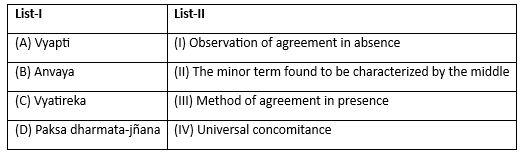
Correct option is D
The terms in
List-I and their corresponding explanations from
List-II are:
1.
(A) Vyapti – Universal Concomitance
(IV): Vyapti refers to the universal invariable relation between cause and effect, where the middle term invariably accompanies the major term.
2.
(B) Anvaya – Method of Agreement in Presence
(III): Anvaya refers to the method of agreement where an effect is observed to occur in the presence of a cause.
3.
(C) Vyatireka – Observation of Agreement in Absence
(I): Vyatireka refers to the method of agreement in absence, where the absence of the cause leads to the absence of the effect.
4.
(D) Paksa dharmata-jñana – The Minor Term Found to be Characterized by the Middle
(II): Paksa dharmata-jñana refers to understanding the minor term (subject) through its connection with the middle term (hetu).
Information Booster:
1.
Vyapti (Universal Concomitance) is a foundational concept in Indian logic for inference (Anumana).
2.
Anvaya (Agreement in Presence) shows a positive relationship between cause and effect.
3.
Vyatireka (Agreement in Absence) is the negative counterpart to Anvaya, highlighting absence as proof.
4.
Paksa dharmata-jñana explains how the middle term characterizes the subject in logical reasoning.
5. Both
Anvaya and
Vyatireka are crucial for validating causal relationships in logic.
 English
 10 Questions
 20 Marks
 12 Mins


