






 Code -
Correct option is D
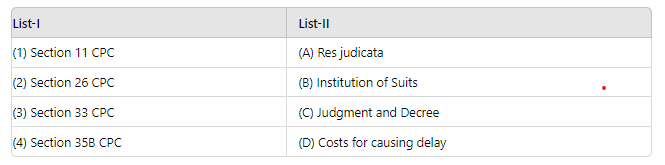
The correct matching between List-I and List-II is as follows:
1. Section 11 CPC (Res judicata): Section 11 of the Code of Civil Procedure (CPC) embodies the doctrine of res judicata. This principle prevents the same parties from litigating the same issue more than once if a competent court has already adjudicated it. The objective is to avoid multiple lawsuits for the same cause of action and to ensure the finality of judgments.
2. Section 26 CPC (Institution of Suits): Section 26 of the CPC outlines the procedure for the institution of suits. According to this provision, every suit is required to be instituted by presenting a plaint to the court or such other manner as may be prescribed by the court. This section emphasizes the formal commencement of a civil lawsuit.
3. Section 33 CPC (Judgment and Decree): Section 33 of the CPC deals with the court's duty after the conclusion of the hearing. It mandates that the court shall pronounce judgment and, on such judgment, a decree shall follow. The judgment is the final decision of the court, and the decree is the formal expression of the court's decision.
4. Section 35B CPC (Costs for causing delay): Section 35B of the CPC is related to the imposition of costs for causing delays in proceedings. It provides the court with the power to order costs against a party that causes unreasonable delay in the progression of the case. This section aims to expedite proceedings and discourage dilatory tactics.
Information Booster:
· Res Judicata (Section 11 CPC): Res judicata is a fundamental concept in civil litigation that prevents the same dispute from being relitigated between the same parties. The doctrine is based on the principle that there must be an end to litigation. Once a court has reached a final decision on a matter, neither party can attempt to bring the same issue before the court again. This ensures judicial efficiency and protects parties from the burden of multiple lawsuits.
· Institution of Suits (Section 26 CPC): The institution of a suit marks the formal commencement of legal proceedings. It involves filing a plaint with the appropriate court, which sets the legal process in motion. The plaint is a crucial document that outlines the plaintiff's claims, the relief sought, and the grounds on which the relief is based. Proper institution of a suit is necessary for the court to take cognizance of the matter.
· Judgment and Decree (Section 33 CPC): Judgment refers to the court's final determination of the rights and obligations of the parties in a lawsuit. Following the judgment, a decree is issued, which is the formal expression of the adjudication. The decree is binding and enforceable and marks the conclusion of the trial process in the court.
· Costs for Causing Delay (Section 35B CPC): Section 35B is a punitive measure aimed at preventing unnecessary delays in the judicial process. If a party to a suit is found to be causing delays intentionally or negligently, the court may impose costs on that party. This provision is intended to deter parties from using delaying tactics and to promote the efficient administration of justice.
Additional Knowledge:
· Incorrect Option (A) - Judgment and Decree: This option incorrectly matches Section 11 (Res judicata) with Section 33 (Judgment and Decree). However, Section 11 deals exclusively with the concept of res judicata, which is unrelated to the court's judgment and decree procedures.
· Incorrect Option (B) - Res Judicata: This option incorrectly matches Section 26 (Institution of Suits) with Section 11 (Res judicata). Res judicata is about the prohibition of re-litigation of the same issue, while Section 26 concerns the initial filing of a suit.
· Incorrect Option (C) - Costs for causing delay: This option incorrectly matches Section 35B (Costs for causing delay) with Section 26 (Institution of Suits). The institution of suits pertains to the commencement of legal proceedings, not to any costs for delays.
· Incorrect Option (D) - Institution of Suits: This option incorrectly matches Section 33 (Judgment and Decree) with Section 11 (Res judicata). However, Section 33 governs the court's actions after a hearing, including issuing a judgment and decree, while Section 26 is about the formal initiation of a lawsuit.


