

hamburger menu
All Coursesall course arrow
adda247
reward-icon
adda247
    arrow
    arrow
    arrow
    Male crickets call at dusk when the light intensity falls below a certain level. A researcher kept these insects in the laboratory under two light reg
    Question

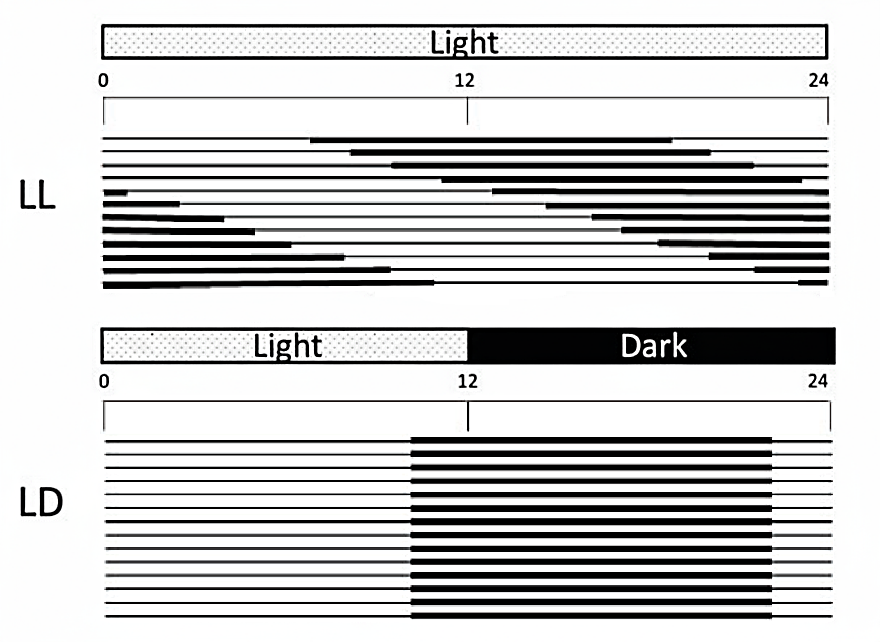
    Male crickets call at dusk when the light intensity falls below a certain level. A researcher kept these insects in the laboratory under two light regimes: i) constant light condition for 24 hours (LL) and ii) 12 hours Light and 12 hours Dark cycle (LD). The calling activity pattern of the crickets in these two regimes across all experimental days is represented in the figure below.

    The statements below represent inferences that one can draw about circadian control of calling activity in these animals.
    A. Calling activity under LL represents free-running cycle and LD represents entrained cycle.
    B. Calling activity under LL represents entrained cycle and LD represents free-running cycle.
    C. The circadian control of calling activity is endogenous only.
    D. The circadian control of calling activity is exogenous only.
    E. The circadian control of calling activity has both endogenous and exogenous components.
    Which one of the following options gives all correct statements about the inferences we can draw from this experiment?

    A.

    A and C

    B.

    B and C

    C.

    B and D

    D.

    A and E

    Correct option is D

    Correct Answer: d) A and E

    Explanation

    The experiment used two light regimes:

    LL (constant light):

    No external cue (no dark period).

    The calling activity gradually shifts over time, meaning it is free-running — controlled by the cricket’s internal (endogenous) clock.

    LD (12 h light : 12 h dark):

    Clear external cues (light and dark).

    The calling pattern stays aligned to dusk each day, showing entrainment to the light–dark cycle (an exogenous cue).

    Therefore:

    A (True):
    LL → free-running cycle (endogenous)
    LD → entrained cycle (exogenous)

    E (True):
    The data show that circadian control involves both endogenous and exogenous components:

    Endogenous rhythm persists under constant light (LL).

    Exogenous light cues synchronize (entrain) the rhythm under LD.

    Information Booster

    Endogenous component: The internal circadian oscillator generates the rhythm.

    Exogenous component: Environmental light–dark cycles reset or entrain the oscillator.

    Both work together in real organisms to keep behavior synchronized with day–night cycles.

    Similar Questions

    test-prime-package

    Access ‘CSIR NET Life Sciences’ Mock Tests with

    • 60000+ Mocks and Previous Year Papers
    • Unlimited Re-Attempts
    • Personalised Report Card
    • 500% Refund on Final Selection
    • Largest Community
    students-icon
    354k+ students have already unlocked exclusive benefits with Test Prime!
    test-prime-package

    Access ‘CSIR NET Life Sciences’ Mock Tests with

    • 60000+ Mocks and Previous Year Papers
    • Unlimited Re-Attempts
    • Personalised Report Card
    • 500% Refund on Final Selection
    • Largest Community
    students-icon
    354k+ students have already unlocked exclusive benefits with Test Prime!
    Our Plans
    Monthsup-arrow
