
Correct option is D
Introduction
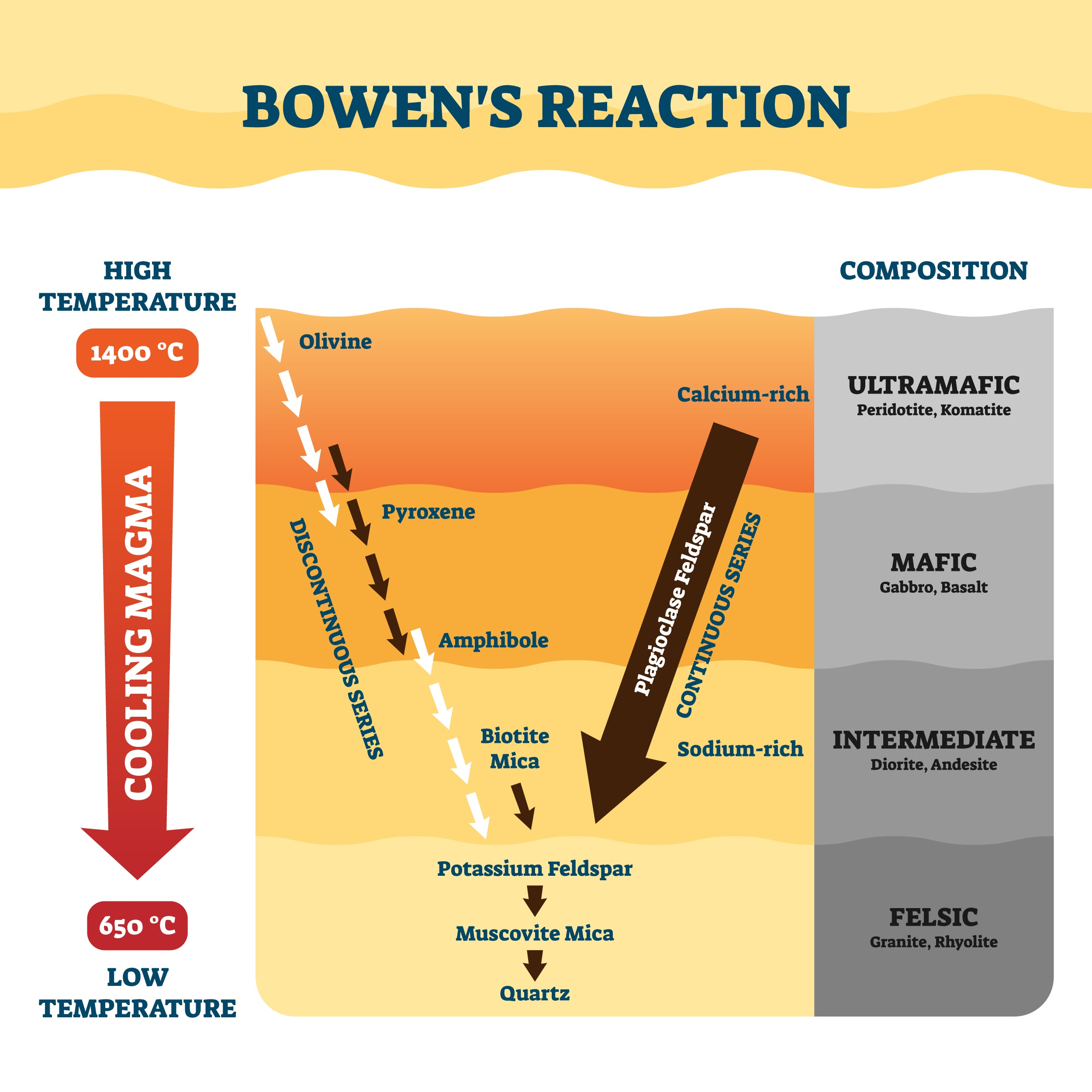
· Bowen's Reaction Series is a fundamental concept in geology that describes the specific sequence in which silicate minerals crystallize from a cooling magma.
· Proposed by N.L. Bowen, the series explains why certain types of minerals are commonly found together in specific igneous rocks while others are never associated.
· The process is governed by the chemical composition of the melt and the decreasing temperature of the environment as magma moves towards the Earth's surface.
Information Booster
· The correct sequence follows the discontinuous branch of the series: Olivine, Pyroxene, Hornblende, Mica (Biotite), and Quartz.
· This branch involves ferromagnesian minerals where each step represents a change in the silicate structure, moving from isolated tetrahedra to complex frameworks.
· Olivine is the first to crystallize at the highest temperatures (approx. 1200°C), making it common in ultramafic rocks like peridotite.
· As the temperature drops, the previously formed crystals react with the remaining melt to form the next mineral in the sequence, such as Pyroxene and then Hornblende.
· Quartz is always the final mineral to crystallize at the lowest temperatures (approx. 600-700°C) because it forms from the silica-rich residual liquid.
 English
 10 Questions
 20 Marks
 12 Mins


