






Correct option is A
Explanation:
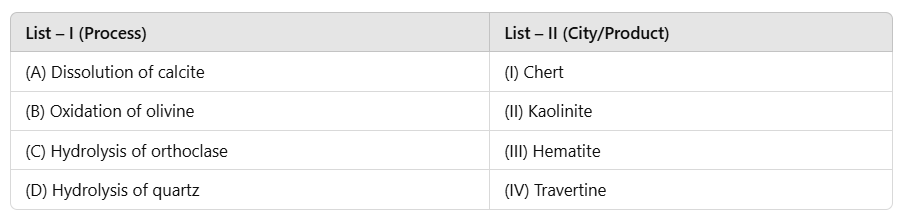
· (A) Dissolution of calcite → (IV) Travertine Calcite dissolves in carbonic acid and reprecipitates as travertine in hot springs and caves.
· (B) Oxidation of olivine → (III) Hematite Olivine contains iron which, when oxidized, forms iron oxides like hematite (Fe₂O₃).
· (C) Hydrolysis of orthoclase → (II) Kaolinite Orthoclase (a feldspar) undergoes chemical weathering, resulting in the formation of kaolinite, a clay mineral.
· (D) Hydrolysis of quartz → (I) Chert Although quartz is resistant, prolonged weathering can dissolve silica which reprecipitates as microcrystalline quartz (chert).
Information Booster:
· Travertine is a form of limestone resulting from the precipitation of calcium carbonate, often from dissolved calcite. Hematite forms through oxidation of ferromagnesian minerals like olivine. Kaolinite is a clay mineral formed from feldspar hydrolysis. Chert, composed of microcrystalline silica, originates from quartz dissolution and reprecipitation, often in marine environments.
Additional Knowledge:
· Option (2): Incorrect – Dissolution of calcite forms travertine, not hematite.
· Option (3): Incorrect – Olivine forms hematite, not chert.
· Option (4): Incorrect – Olivine and chert are mismatched; orthoclase does not form chert.
 English
 10 Questions
 20 Marks
 12 Mins


