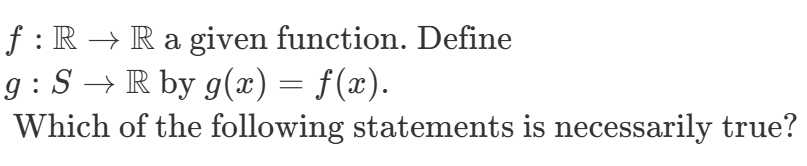
Correct option is D
Intermediate value theorem:
The Intermediate Value Theorem (IVT) states that if a continuous function takes two values at some points
and the function is continuous between these points, then it must take any value between them at some point in that interval.
Let,
Now Let f(x)=xkand,h(x)=f(x)−g(x)if k=odd:n→−∞lim[xk−g(x)]=−∞ (∵g is bounded)⋯(1)n→∞lim[xk−g(x)]=∞,and h(x) is continuous in R ⋯(2)
Applying I.V.P we can say that h(x) acuires all values in R.
⟹∃x0∈R:h(x)=0 if k is odd⟹∃x0∈R:f(x0)=g(x0) if k is odd.Option D is correct.
And if k is even then both the limits in (1) and (2) will be ∞ .
and we will not be able to apply I.V.P so all other statements are not necessarily true.